Sunday, February 23, 2014

When Pigasso Met Mootisse

This story has many admirers among art teachers. There should be more admirers among early childhood educators. It has everything! War! Grudges! Messes! Hurt feelings and most importantly: Making up. The story is based loosely upon the friendship of Pablo Picasso and Henri Matisse, with animals subbing for the historical humans. 

The children are enthralled with super-heros and fighting, as so many children are. When I started reading When Pigasso Met Mootisse to my kids two years ago I was not convinced it would hold their attention. What I discovered was that the concept of an "art attack" hit the sweet spot in their fight-loving brains. Subsequently I also discovered that fighting for fighting's sake wasn't what they were really interested in. They were in love with the brio of the battle between opposites.  In super-hero stories, it was the battle between good guys and bad guys. In this story it is the battle between two different styles of self-expression. Feelings run very high in either case, but the idea is the same. 

So we are thinking about doing a "unit", as we say in the biz. 

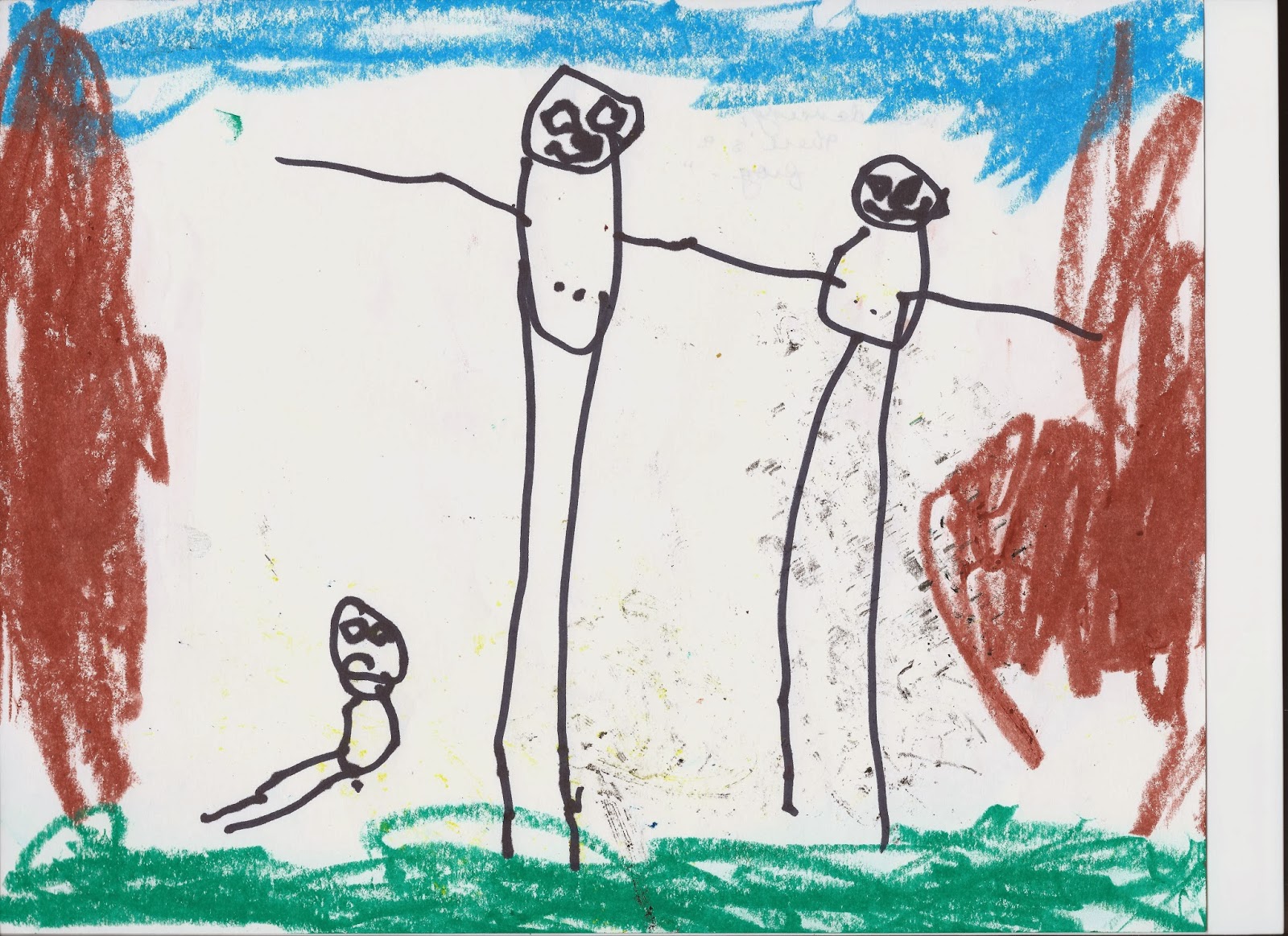
The children mostly favored Picasso's style of art, which is cubism in the story. All of the blogs I've looked at show children's versions of Picasso portraits. They are way cool, folks. I applaud the teachers who give explicit directions, teach art style, and still get creative, individual results. I'm of two minds about this. I love the result. The children get away from houses, butterflies, ninjas, etc. for a while, as my friend, Angelique, says in her blog. They produce something original, with a set of learned skills and techniques. There is so much value in this. The children, as another art teacher friend has said, need to be taken seriously. On the other hand, in our program, which values process over product, we usually give materials, scaffolding, and time. We ask them for their ideas. We even wait for them. Can we resolve these two approaches? 
Should we ask them to produce their own Picassos? Or should we expose them to Picasso and give them the materials and time to see where their inspiration leads? 

What do you think?

Tuesday, January 21, 2014

How to Use an Opera to Teach Nearly Everything--An Integrated Study for Pre-K

I sang with Frederica Von Stade twice at the Washington Opera. I was one of six "spirits" in a wondrous Canadian production of Cendrillon, produced there when I was (ahem) young. Soon after, when I began teaching young children, not knowing that children weren't supposed to be taught about opera, I introduced Von Stade's performance in Humperdinck's Hansel and Gretel from the Metropolitan Opera to my unsuspecting young students. And not knowing that they weren't supposed to understand opera, they fell in love with it. I developed a unit for the opera and the story that included writing, drawing, acting, singing, and what I called "stage magic" (making something appear to be real when it is not).

Fast forward many years and we come to a holiday season when my teaching partner was going to be in her native Australia for three weeks, and I was planning for sixteen rather than eight children. What to do? Duh! Hansel and Gretel, of course!

I introduced the unit with storybooks, like any good unit about a fairy tale. This story in particular isn't devoid of controversy. Teachers routinely caution me about it. "The mother tries to get rid of them. It has a witch. It isn't appropriate for preschool." Well, yes, the mother, or step-mother is a problem. I use at least two versions of the fairy tale, especially Beni Montresor's version.
Signor Montresor created the picture book from the opera's libretto, which has the mother shoo her children out the door to pick wild strawberries in the woods. They get lost and the rest of the story is more or less the same. We also read James Marshall's version, which is comic to adults, but still has the mother trying to lose her kids. We discussed the two stories and I polled them on their favorite one. The children were split. The more nurturing the children, the more they preferred the Montresor. The more exuberant preferred Marshall.

This is when I brainstorm with them about how stories can be told, and introduce the concept of singing a story. Do you want to see the story sung? Well, what do you think they said?

We watched the video of the opera bit by bit over a few days. The children asked many questions as we watched, such as, 1.) Why are the people are always singing?  2.) Is that Hansel a boy or a girl (the role is a "pants role". 3.) Is the witch really flying? (she is in a harness and flies in on wires) 4.) Why is her tongue green? (Let's suck on a green candy to find out about stage magic.) and on and on!

We sang "Brother will you dance with me?". We created a giant cardboard cookie to use to pretend to turn each other into one, like they turn the witch into one in the opera. Then the question came up, one that other classes haven't asked before: "Can we do it as a play?" One boy in particular lobbied to be the witch.

Ah! The emergent curriculum teacher rejoices! "Well, of course!" And so it began.


Gail casting the production.

First we have to agree on who is doing what. It isn't nearly as difficult as you might think. Four and five year olds can be highly motivated and focused when they want to do something together that involves every part of themselves. They easily accept double and triple casting so everyone gets to do the roles they wish to portray. They accept direction (not always true of divas and divos). You don't have to talk to them in high motherese. You can direct them and yet accept  their creative proclivities at the same time. It is a joy, pure and simple.

It helps a teacher to know the opera plot well. There are characters the children adore that aren't in the storybooks, such as the dew fairy and the sandman, or all the enchanted animals portrayed by children in the video of the opera production. They revel in the happy ending, when the mother and father find the children and everyone sings and dances in jubilation (this was their favorite scene to portray, besides tearing up and pretending to eat the gingerbread witch). It is sort of a "Ding Dong, the Witch is Dead", but the music is Wagnerian (Humperdinck was a student of Wagner).

Originally I had planned to have the children make a book to contribute to the library for the other children. I honestly believe they were more prepared to do this after they had explored the story and it's themes through drama. So I gave each of them a scene from the opera story to illustrate, and we used new art material for the illustrations: Sharpies and Creamy Crayons.
The first step

The first step was for each child to draw what they remembered about the scene they were assigned. The above picture is one girl's favorite: The angels coming from the wings and above to guard the sleeping children in the forest. She chose triangles because "they would be pretty" as angel regalia. 

The second step was to use the colors. The above girl chose to color only the angels. 
Others put color into their illustrations to represent the set...

"I wanted the ceiling to be blue, the walls brown, and the floor green. It's Hansel and Gretel in their house, and I drew a frog, because I like frogs." 

The book will be laminated and bound next week. I will be delighted to share their reactions when it happens!

So how have I proved you can teach everything through a project like this? I can use standards to show how they have been met. 

The Virginia Foundation Blocks for Early Learning include standards for visual arts: Create specific works of art based on a common theme, .and: Develop and use fine motor skills necessary to produce two...dimensional works of art. For Language Arts, they list: Use size, shape, color, and spatial words to describe people, places, and things.


I thought that these standards were addressed and then some, so I took a look at the Kindergarten SOL's for visual art and language arts as well: "The student will describe the sequence of steps in making a work of art", and: "The student will comprehend fiction by retelling familiar stories using beginning, middle and end. Also: Discuss characters, setting, and events."
When a teacher uses the arts to teach, standards are met naturally. In fact, standards are exceeded. 

Let's revisit the classroom to see what the children decided to do after they had digested the story of Hansel and Gretel thoroughly, acted it out, and made a book out of it. I asked them if they would like to invent their own version of the story. I suggested they add a helicopter, a la Gianni Rodari, , an idea that tickled them. They took turns speaking, and this was the result.

Once upon a time there was a boy and girl named Hansel and Gretel. They lived in a forest. A  helicopter came and took them to another part of the forest. They thought they were at their house but they were at a witch's house. The witch came down in a plane, not wires (like in the opera). Gretel saw something to distract the witch, a tunnel. Gretel freed Hansel and when the witch was coming out of the tunnel they pushed her into the oven. She came out as a witch cupcake! They ate it. Then they danced. 
The End.

I think they "got" the idea of stories, don't you?


Tuesday, December 10, 2013

How We Went from the Farm to a Phone Booth.

My totally cool colleagues created a phone booth for the children. How did we get to a phone booth? By emergent curriculum and the Project Approach.

Curriculum that emerges out of the interests of children and teachers has been very important to Early Childhood Education, at least in the preschool years when standardized testing has yet to make an appearance. It is a concept carefully explained in a multitude of textbooks from which I teach, and you can find many resources by googling the term. I want to describe a process from my own center, so that its example can be examined by others. Everything that emerges doesn't necessarily have to be extended or studied, but sometimes they are, and they become a project. In this case, a metamorphosizing project.


So how did a dramatic play area be transformed from a farm to a grocery store and then to a grocery store with an old fashioned (British-style) phone booth in it? Was this whimsy? Well,...yes, but read on!

In October we went on our annual field trip to the Potomac Vegetable Farm.. The children enjoyed a hayride, a walk through plantings both common and uncommon (who would have thought Coltsfoot was grown in a vegetable farm, but it is commonly used in stews in England. My teaching partner, Sue, told the children about eating it in wonderful, aromatic stews as a child growing up in Australia. We also ate cherry tomatoes straight off of the vines. Yum!)

The children enjoyed the pigs and hens. One girl almost fell into the pig pen by leaning as far out as she could. She wanted to pet a pig!
We ended with a picnic, and buying vegetables for our afternoon snack table at the center.

The dramatic play area quickly became a farm. The children made vegetables for planting, and used masking tape for rows. No, we did not use plastic vegetables. They are very colorful and fun, but they cut out a step necessary to our approach: The children need to do whatever they can to contribute to the project. We don't magically do it for them. They have ownership, an important part of self-esteem and self-efficacy. Fine motor skills get their due, without artificial activities to practice them.
After a while the farm idea got old. The children didn't play in it anymore and at the same time they began showing an interest in cooking and recipe writing. So...
I put out flower, oatmeal, sugar, salt, spices and water. I told them they needed to "write" a recipe before they cooked. So they drew pictures and invented spelling of the ingredients they wanted in their cooking, and "followed" the recipe on trays. We even put some of the concoctions into little cups, and put them in the fridge to see how they would change. The children predicted results ranging from actual cookies to "mush!". They wanted to cook again and again I decided that they needed to actually do the real thing. With Thanksgiving approaching we decided to make applesauce and pumpkin pudding. Of course they wrote recipes, first! The amazing thing about an emergent curriculum is that writing practice is painless. Children are motivated to use the tools of emergent and developmental writing when they have something they dearly want to do! Each child participates at his or her own level.

Pretend Cooking
Pretend cooking and actual cooking easily introduced the idea of where the crops go from the farm. Children are very much aware of grocery stores and what they can (and sometimes can't) get from them! They began bringing in empty cartons and containers from home. Our amazing teacher, Carrie, made shelving, and they were stocked by the children. We hauled out the toy cash registers. Did we use play money? NO! The children were more than happy to produce money at an alarming rate, and much of it had numbers on it (Ah ha! There's that emergent math!). They learned through trial and error that the money needed to fit the cash register drawers so they began cutting it down. All the while they were shopping and checking people out, taking their food "home" to the library and the loft. Social skills were tested through negotiating who would be checkers and who would shop. I suggested creating a crew of "Night Stockers" but that was voted down by my colleagues. The children never see the night stockers. They aren't a part of their shopping experience.

Which brings us to the phone booth...

When I was little, every grocery store had some form of public phone either inside or out. In Australia, Sue says there are still red, British-style phone booths. Phone booths are a part of our childhood memories, not of our students'. But we described them, each in turn, to the children, emphasizing that, once upon a time, people didn't carry phones in their pockets! There were public phones and people actually stood in line to use them. The children were entranced.

So Carrie and Sue made one out of cardboard, plastic, paint and duct tape. And the children began lining up to use it. It was and is a delight for all of us.

So here it is, a documentation of a series of projects and activities that emerged through the day to day life of a multi-age classroom of three and four year olds. I didn't even mention the books we read as part of our work with the children, but there were many. There was probably more we could have done. But having done this much has been a joy for everyone. And the emergence of curriculum will doubtless continue.


Saturday, August 24, 2013

Becoming a Life-Long Learner

I will start backwards, since backwards design is the rage...
This is the Welcome Symbol of our stairwell ocean. He/she is an octopus made by children, stuffing shredded paper into stockings and gluing buttons on the tentacles to represent suckers (Wiki Answers says they are called that. I'm not making it up!). I suggested that, as younger children are starting in a week, we may have to give the octopus a smiley face, to make sure they aren't put off preschool permanently.

Seriously, though, the ocean in the stairwell is painstakingly designed and executed by creative teachers and eager children. The children take full ownership, calling it "Our Ocean". I shiver with delight when I hear this.

Since I do teach integrating the arts with curriculum, and emphasize project learning, this is a terrific example for me to document. What is at the top of the ocean? At the bottom? In the middle? What are these zones called? The stairwell answers and illustrates them answers. Our incredibly creative teacher, Carrie, made the adult signs for explaining to parents what we all have been teaching. There are various zones of depth that have differing amounts of light, and the sea life of each zone is adapted to that light. I do not intend to explain that here, but would rather show pictures and comment on the cross-curricular opportunities afforded by teaching this way. To have children just barely four and children turning five and a half participate in a project where each child has a creative role and can explain their own understanding of the learning appropriate to their developmental level is what we call "best practice" in the business. I call it amazing.

Our children used reference materials to illustrate their understandings. Sometimes they strove for accuracy and sometimes for whimsy. Being young children they usually combined the two to some degree.
Invented or developmental spelling is a literacy element in the project. Children sounded out the zone beside the adult explanations of each zone.
The most colorful and elaborate part of this exhibit is the coral at the top of the stairs. Children painted the coral and cut out sections. They helped tape the pieces up with teacher guidance. Fish and other sea life were added to show how they lived among the coral, which itself is alive.

The deep water has unusual sea life, not often shown in children's storybooks so it is helpful to portray it.
Jellyfish, made with coffee filters and either yarn or paper curls, were very popular with the children. They enjoyed both making and helping to hang them.
At the bottom of two flights of stairs lay the "trenches" where the life that can live with little light resides. Here we have an example of that life, an explanation, and a child's attempt to write the name of the zone. Accuracy isn't the point. The attempt to express meaning through letters and pictures is a hallmark of early and developmentally appropriate literacy practice.

I could go on, but I hope I've made my points. As I wrote in my first post about this project, children in the fifth grade are learning this material. And they are doing most excellent reading and writing, listening and discussing, I'm sure. When our children arrive at the fifth grade, they will have had this grounding experience of having been immersed in the life of the sea, a virtual world in the stairwell of their school. During the years between now and then we hope they will retain their keen love of participating in their own planning of projects, and that they will own their own learning. This is what we as educators want for our children. This is what makes a "life-long learner".


Thursday, August 1, 2013

How to teach complex ecosystems to young children.


When walking down the stairs becomes walking to the bottom of the ocean...
Carrie, my inventive colleague, is creating the ocean in our two-floor stairwell. She read to her group about the different sea life at different depths. Her group is almost all four now, and they can explain, in their amazing way, what kinds of sea life is found, and what they need to live. Since I close the center two days a week I have the luxury of listening to them share the book with me. This is how I know they comprehend depth and light at each level, and some of the creatures who inhabit them. I must tell you something amazing: When I came to work Monday and started up the stairs, I had the uncanny sensation of being at the bottom of the ocean, walking up to light. I also perceived something similar to what I perceived entering the Rothko room at The Phillips Collection: Profound mystery.

The week before she had large paper out, different shades of blue paint, and children were helping her create her stairwell masterpiece. So I knew something was up, but not exactly what. She has presented our teaching team with a wonderful challenge to invent different ways for the children to interact with our "ocean". Sue and I are discussing sharing Sue's scuba diving hobby, and my own interest in teaching concepts through music and movement. Carrie and her partner Anne will be initiating art activities to populate the ocean with dwellers at each level of depth. Perhaps we will visit an aquarium. There are so many possibilities opening for project work because of simple paint, paper, and a mundane stairwell.

The stamp of approval came from an unlikely source. One of the local elementary school principals came to observe a future student (they do this routinely, kudos to Arlington Public Schools) and remarked, on ascending the two floors, that she should bring her fifth graders to our stairwell. They are learning about the ocean ecosystem. Experiencing it virtually (not digitally) would help their learning. Quite a feather in a certain teacher's cap, I'd say.

Learning to learn

A month and a half later, we are sitting in morning meeting, and I show our group a flyer from the Washington Opera's coming 2013-2014 season. On the front there is a color picture of the three ladies from Magic Flute confronting the (two-headed!) dragon over the fainted body of Tamino. I show this flyer to our children and they exclaim in joy--"Magic Flute! Look at that dragon!". A visiting former student asks, "Is he dead?". A student patiently  explains, "He's the prince Tamino". Another: "He fainted when the dragon came." They begin reminiscing about the performance, and who was whom, leaving the visitor baffled. She had never heard of this story that our four/five year old children know so intimately and recount with such enjoyment. And she is almost seven! 

I have written about the benefits of the project approach, and about how music connects with language in the brain to form richer concepts, and improve long term memory. But what about what I consider to be the dirty little secret in early childhood education? Many practitioners do not know how to or want to share the realms of art with young children because they themselves do not feel comfortable with them (the realms, that is). My adult students are usually enthusiastic about learning new ways to provide arts experiences, but many teachers have difficulty envisioning going beyond the traditional format of providing pre-cut pieces of paper or even coloring sheets to cut out and form scenes or stick puppets, or other "art". Thinking outside the box is possible but going there? Maybe not. Using classical music is considered great for "calming" children but giving them the experience of music and drama? Maybe not. If teachers think that learning about new children's authors is exciting and fun, they do not always think so about learning to appreciate opera and ballet. Yet young children are so drawn to these forms of art when the teacher is also open and enthusiastic about them.

What is needed is training that demonstrates to teachers that they can learn about anything new (as they expect their students to). Just as they learn about sea life to teach about it, they can learn about Mozart (start with Mozart's Magic Fantasy). They can explore Wikipedia and YouTube. They can talk to friends who are familiar with these theater arts and ask questions. Just as children ask questions to learn, so can we, the "big kids" who teach them. The teacher's brain must continue to make connections in order to be fresh and open to everything children can learn. And they must not underestimate their own ability to learn, anymore than they do their students'.


Saturday, June 22, 2013

Finishing a Project and Reflecting on Arts-based learning.

Our Pre-K children performed their version of Mozart's  Magic Flute yesterday morning. Mozart wouldn't have recognized much of it, nor would have the librettist, Emanuel Schikaneder. But I expect they would have enjoyed the enthusiasm, and comic proclivities of the children performing their Singspiel. Mozart and Schikaneder created this work, Mozart's only one in their native German, as a folk opera, one that would appeal to the average Austrian. The music, however, is anything but average. Thus it mesmerized many of children from the moment they heard it. Young children are born to love music of all genres and types. They are genetically predisposed to it., as Oliver Sacks says in his book Musicophilia. 

Doing an opera (however truncated and strangely nonsensical ours was) can be challenging in preschool. Since ours is a childcare program as well as preschool, our "events" aren't always planned in conjunction with parents'. Our Papageno (the boy who said he was interested in this rich, comic part) left for Lebanon with his parents along with his twin brother the Dragon. Our stately Queen of the Night found out she was going camping on a Thursday when our performance was Friday. So our Sarastro was promoted to Papageno, (I cut Sarastro. My husband, being a baritone with bass tendencies, was horrified.) My teaching partner, Sue, who had been in Florida the whole week of rehearsals, stepped in as the Queen of the Night, and I gleefully subbed in as the Dragon. One of the three ladies left for Iran to visit relatives before we performed. The two left declared themselves the "Two Ladies", which solved that casting problem. Children solve our difficulties more easily than we do, and with much less angst. 

But, oh, the hilarity and joy of it: Monostatos and his henchman going from a state of fierce depravity (chasing Pamina around the stage) to one of delighted dancing at the sound of Papageno's bells (toilet paper tubes taped together and strung with jingle bells). Tamino trying to kill the dragon (me) with his cardboard sword and then feigning a faint so that the Two Ladies could bend over him and say how handsome he was (a sturdy girl played the Prince--she jumped at the chance). Papageno dancing a Snoopy dance facing the parents and younger children like a trooper while I played his introductory music. Yes, we used music liberally. My only regret is that I am not more technically savvy so that I could line up a series of music files of just the right portions. A young staffer told me, too late, that it could be done. "Oh, Brave New World..."!

All of the props, from the magic flute itself, Papageno's pan pipes and magic bells, to the lock for Papageno's mouth, were made by the children during activity time over the course of two weeks. The sets were made by the children with design help from my partner, Sue. I "directed" and stage-managed but gave the cast as much freedom as I could to interpret their roles. The "Two Ladies" took it upon themselves to let me know when I had forgotten anything. The children too shy to talk onstage were happy to become the animals enchanted by Tamino's flute.

With the interest in the arts in early childhood growing, it is dispiriting to hear from my adult students about how impoverished many of our programs still are in this regard. How better to promote literacy, fine motor skills, long-term memory, and body/brain integration than to give them a story with music that they themselves are willing to do? How better to nurture design (cognitive/spatial abilities) than to ask them to come up with a prop created with cardboard, paper, straws, tape and buttons? Teacher scaffolding replaces teacher creating, teacher dictating. Children gain confidence in their own abilities. Along the way they hone all of their skills. How freeing this approach is! 

Yes, it is work. It is absolutely so much easier for teachers to follow set lesson plans year after year, using the usual themes and activities. Children will respond to these. They are generous souls. They don't know that there is a better way. 

Using the arts (and I mean art, not craft) as a road to learning motivates children to do their best and be proud of the results. And it doesn't require magic.