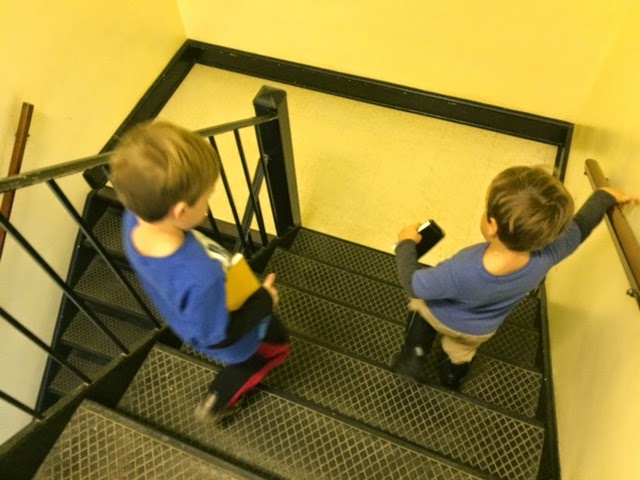
Young boys going to an assignment
Taking their new notebooks and pens, John and Phillip (not their real names) proceed down the stairs to interview one of the teachers of the twos, Sarah. They talk to one another on the way down, trying to decide what questions they will ask her about her job. They enter the classroom, welcomed by the twos teachers, and sit on the floor, ready to write. Here are some of the questions:
Where do you work?
What's your schedule?
What days do you work?
When do you go to work?
Why do you work?
and lastly,
What time do you go to bed?
These questions are simple, and maybe even obvious, but Sarah treats the children with respect, appearing to contemplate her answers before she gives them. She explains that she works at our center, that her schedule varies each day,and that she works every weekday. She pauses at the question, Why? How do you explain the reasons for working to small children? She makes the answer seem totally obvious! "I work because I love children, and I need money to buy food". One of the boys admits that his parents work to earn money as well. Sarah decides to say that she goes to bed at ten every night; something the boys understand--they also have a set bedtime!
During the interview John and Phillip write down the answers, asking Sarah for spelling when they feel unsure of their developmental writing skills.
The next step is to format this edition of our paper, inserting the interview, with pictures taken by myself. Parents will read the stories on the walls of the school, and other children will get to interview our Director. Some stories have been about the new marble run in Creation Station, or about a mother's visit to tell about her newspaper job at the Washington Post.
Organically, we integrate developmental spelling, drawing, speaking and listening skills into a whole. The whole is more than the sum of its parts. Not only are we integrating literacy and social studies, but we continually nurture connections within the community. Teachers, parents, children are all linked in a learning journey. In a Pre-K program, nurturing relationships between and among all members of the community makes for excellence in education. This is how it should be.


