Showing posts with label drama. Show all posts

Monday, January 8, 2018

Stories to Teach about Life

 “Yes!” I thought, reading Peter Gray’s blog post about the importance of stories for young children. My mind traveled back to all of the stories I have read, and acted out with, young children over the course of my career. Dr. Gray focused specifically on reading to children; how this act has been singled out, with good reason, to be more important to the future education of children than most others. His excellent point is that there is more to story reading than cuddles and close relationships, though these are essential for human growth and development, not to mention human joy!
“Knowing how to deal with evil as well as love, how to recognize others’ desires and needs, how to behave towards others so as to retain their friendship, and how to earn the respect of the larger society are among the most important skills we all must develop for a life.”  These skills are actually something we learn all through life, but giving children stories to reflect on gives them a huge advantage, psychologically, as an early start on braving human relationships, and fostering skillful interactions. Dare I say, also, that stories help children learn to be wise rather than right, as in, “right, not wrong”?

One book that, surprisingly, became a favorite with a group of pre-k students, and demonstrated the difference between wisdom and “might makes right”, was The Cloud Spinner, by Michael Catchpool and Alison Jay. This entrancing story starts out, “There was once a boy who could weave cloth from the clouds”. The boy sings as he works: “Enough is enough and not one stitch more”. Immediately, Alison Jay’s illustrations captivated our children. The hills and houses reflect the moods of the characters. Our children noticed this before I did! Smiles on hills are made of trees, and sheep. Houses smile with windows and doors. In the beginning, nature is in harmony because the boy with his magical loom only makes what he needs. One day, the king notices the boy in a crowd and madly desires clothing, of both himself and his family, made of the clouds. He commands the boy to weave for him. The boy balks at first: “It would not be wise to have (so much fabric) made from this cloth. Your majesty does not need it.” The king is apoplectic, commanding the boy do his bidding. So he does. He weaves, and the illustrations reflect the sadness of the task with darkening color and forlorn hills.


The Cloud Spinner does not so much have a cheerful ending as a wise and uplifting one. The children, absorbed in it, noticing details of the varying shades of color that reflect the boy’s, and the King’s daughter’s moods (She helps him to reverse the tragic disappearance of clouds that cause drought, and discontent among the people). The King and his family are astounded by the gratitude of the people after the clothing he ordered is turned back into clouds, causing welcome rain. The boy and princess exult in the restoration of a wise order in nature and among humans. The children, sitting before me, sigh in contentment.

Our preschoolers learned about what greed was, some demonstrating it by acting out the concept—“Mine! Mine!”, with gestures of raking in loot! A teacher took up the phrase, “Enough is enough and not one ____ more” when children wanted ALL the blocks, or pizza. And, amazingly, this story was one of the most requested during reading time, rivaling Dragons Love Tacos!
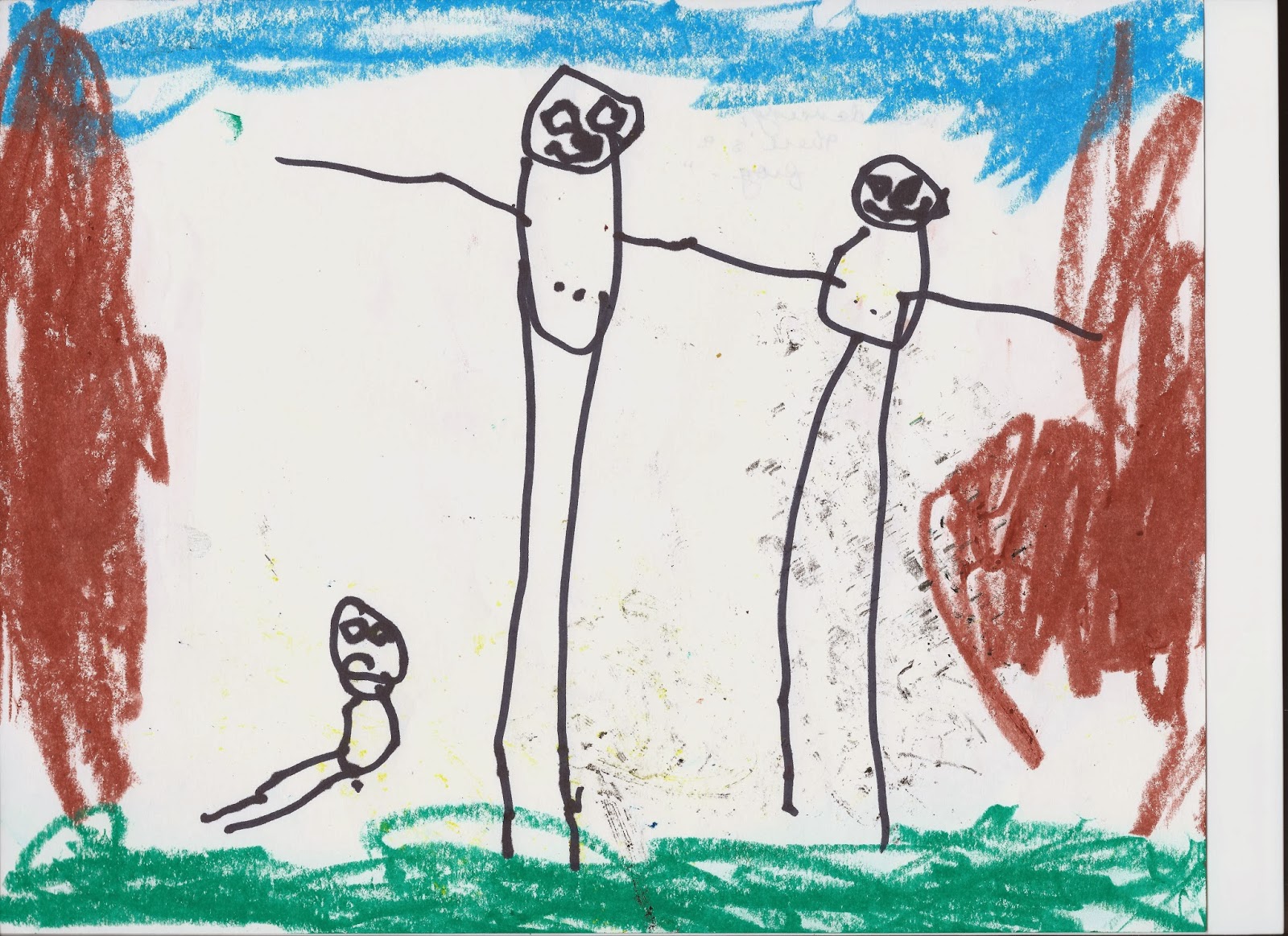
If children have a deep interest in this or any other story, it is wise to follow their direction and see what they do with it. Our children drew and painted clouds in an array of colors, and told stories with greedy characters and children with magical powers. If you teach to standards, these activities can be used to fulfill them—Language arts, social studies, even math and science. Arts standards go without saying, and the text of the song can be set to music. Ask any child! They will have a tune before you know it!

Children do need stories to make sense of feelings and wise social interaction. They need myth, I dare say, to hold on to the important values of society. As human interaction and social relationships are varied, so, too, are the stories we read and tell.


Tuesday, January 21, 2014

How to Use an Opera to Teach Nearly Everything--An Integrated Study for Pre-K

I sang with Frederica Von Stade twice at the Washington Opera. I was one of six "spirits" in a wondrous Canadian production of Cendrillon, produced there when I was (ahem) young. Soon after, when I began teaching young children, not knowing that children weren't supposed to be taught about opera, I introduced Von Stade's performance in Humperdinck's Hansel and Gretel from the Metropolitan Opera to my unsuspecting young students. And not knowing that they weren't supposed to understand opera, they fell in love with it. I developed a unit for the opera and the story that included writing, drawing, acting, singing, and what I called "stage magic" (making something appear to be real when it is not).

Fast forward many years and we come to a holiday season when my teaching partner was going to be in her native Australia for three weeks, and I was planning for sixteen rather than eight children. What to do? Duh! Hansel and Gretel, of course!

I introduced the unit with storybooks, like any good unit about a fairy tale. This story in particular isn't devoid of controversy. Teachers routinely caution me about it. "The mother tries to get rid of them. It has a witch. It isn't appropriate for preschool." Well, yes, the mother, or step-mother is a problem. I use at least two versions of the fairy tale, especially Beni Montresor's version.
Signor Montresor created the picture book from the opera's libretto, which has the mother shoo her children out the door to pick wild strawberries in the woods. They get lost and the rest of the story is more or less the same. We also read James Marshall's version, which is comic to adults, but still has the mother trying to lose her kids. We discussed the two stories and I polled them on their favorite one. The children were split. The more nurturing the children, the more they preferred the Montresor. The more exuberant preferred Marshall.

This is when I brainstorm with them about how stories can be told, and introduce the concept of singing a story. Do you want to see the story sung? Well, what do you think they said?

We watched the video of the opera bit by bit over a few days. The children asked many questions as we watched, such as, 1.) Why are the people are always singing?  2.) Is that Hansel a boy or a girl (the role is a "pants role". 3.) Is the witch really flying? (she is in a harness and flies in on wires) 4.) Why is her tongue green? (Let's suck on a green candy to find out about stage magic.) and on and on!

We sang "Brother will you dance with me?". We created a giant cardboard cookie to use to pretend to turn each other into one, like they turn the witch into one in the opera. Then the question came up, one that other classes haven't asked before: "Can we do it as a play?" One boy in particular lobbied to be the witch.

Ah! The emergent curriculum teacher rejoices! "Well, of course!" And so it began.


Gail casting the production.

First we have to agree on who is doing what. It isn't nearly as difficult as you might think. Four and five year olds can be highly motivated and focused when they want to do something together that involves every part of themselves. They easily accept double and triple casting so everyone gets to do the roles they wish to portray. They accept direction (not always true of divas and divos). You don't have to talk to them in high motherese. You can direct them and yet accept  their creative proclivities at the same time. It is a joy, pure and simple.

It helps a teacher to know the opera plot well. There are characters the children adore that aren't in the storybooks, such as the dew fairy and the sandman, or all the enchanted animals portrayed by children in the video of the opera production. They revel in the happy ending, when the mother and father find the children and everyone sings and dances in jubilation (this was their favorite scene to portray, besides tearing up and pretending to eat the gingerbread witch). It is sort of a "Ding Dong, the Witch is Dead", but the music is Wagnerian (Humperdinck was a student of Wagner).

Originally I had planned to have the children make a book to contribute to the library for the other children. I honestly believe they were more prepared to do this after they had explored the story and it's themes through drama. So I gave each of them a scene from the opera story to illustrate, and we used new art material for the illustrations: Sharpies and Creamy Crayons.
The first step

The first step was for each child to draw what they remembered about the scene they were assigned. The above picture is one girl's favorite: The angels coming from the wings and above to guard the sleeping children in the forest. She chose triangles because "they would be pretty" as angel regalia. 

The second step was to use the colors. The above girl chose to color only the angels. 
Others put color into their illustrations to represent the set...

"I wanted the ceiling to be blue, the walls brown, and the floor green. It's Hansel and Gretel in their house, and I drew a frog, because I like frogs." 

The book will be laminated and bound next week. I will be delighted to share their reactions when it happens!

So how have I proved you can teach everything through a project like this? I can use standards to show how they have been met. 

The Virginia Foundation Blocks for Early Learning include standards for visual arts: Create specific works of art based on a common theme, .and: Develop and use fine motor skills necessary to produce two...dimensional works of art. For Language Arts, they list: Use size, shape, color, and spatial words to describe people, places, and things.


I thought that these standards were addressed and then some, so I took a look at the Kindergarten SOL's for visual art and language arts as well: "The student will describe the sequence of steps in making a work of art", and: "The student will comprehend fiction by retelling familiar stories using beginning, middle and end. Also: Discuss characters, setting, and events."
When a teacher uses the arts to teach, standards are met naturally. In fact, standards are exceeded. 

Let's revisit the classroom to see what the children decided to do after they had digested the story of Hansel and Gretel thoroughly, acted it out, and made a book out of it. I asked them if they would like to invent their own version of the story. I suggested they add a helicopter, a la Gianni Rodari, , an idea that tickled them. They took turns speaking, and this was the result.

Once upon a time there was a boy and girl named Hansel and Gretel. They lived in a forest. A  helicopter came and took them to another part of the forest. They thought they were at their house but they were at a witch's house. The witch came down in a plane, not wires (like in the opera). Gretel saw something to distract the witch, a tunnel. Gretel freed Hansel and when the witch was coming out of the tunnel they pushed her into the oven. She came out as a witch cupcake! They ate it. Then they danced. 
The End.

I think they "got" the idea of stories, don't you?


Sunday, February 24, 2013

Can the Arts Save Education?

Can the Arts Save Education?

Yes!
Okay, I'm done.
No, seriously, the arts are the new go-to solution for failing schools.

We have tried extrinsic rewards, or "positive reinforcement" through certificates, stars, stickers, contests, jellybean jars, and praise ("good job!"). We have tried testing out the wazoo, tying test scores to teacher pay (a miserable form of behavior modification that fails our children so why try it with teachers?). We have tried speeches and grand-standing. We've tried firing teachers. Has any of this improved test scores or even stopped the downward slide in many schools?

No!

The definition of insanity is doing the same sort of thing over and over again, expecting that the next time it will work. How we have been trying to improve education is, by that definition, insane.

The arts are instrinsically motivating. The arts instill not only discipline but a desire to pursue discipline because that discipline helps the individual to improve at what they most love doing. Pursuing an artistic endeavor nurtures self-esteem and integrates the mind, body and emotions. Teaching through the arts motivates children to go more deeply into a subject because they are more committed to the process of learning. Finally, states are getting serious about giving the arts their due. "There's lots of evidence that kids immersed in the arts do better on their academic tests".  In many schools children are being taught through project work that includes some art form, be it music, movement, drama or dance. You won't find this in the school just around the corner, necessarily, but it is happening out there.

I have written extensively about project work and arts integration in early childhood, specifically in preschool. During the Bush years my graduate professors often spoke wistfully about how preschool education was ahead of elementary education. High-stakes testing and the emphasis on teaching reading and math to elementary school children through "scientific" methods have failed to live up to their promise.

Teaching and learning through the arts gives children the juice, the food they need to want to learn. It is satisfying and intrinsically rewarding to create, using new knowledge and information, with the guidance of a teacher who understands integrating curriculum and artistic work. Children are hungry for this. Let's feed them.