I sang with Frederica Von Stade twice at the Washington Opera. I was one of six "spirits" in a wondrous Canadian production of
Cendrillon, produced there when I was (ahem) young. Soon after, when I began teaching young children, not knowing that children weren't supposed to be taught about opera, I introduced Von Stade's performance in Humperdinck's
Hansel and Gretel from the Metropolitan Opera to my unsuspecting young students. And not knowing that they weren't supposed to
understand opera, they fell in love with it. I developed a unit for the opera and the story that included writing, drawing, acting, singing, and what I called "stage magic" (making something appear to be real when it is not).
Fast forward many years and we come to a holiday season when my teaching partner was going to be in her native Australia for three weeks, and I was planning for sixteen rather than eight children. What to do? Duh! Hansel and Gretel, of course!
I introduced the unit with storybooks, like any good unit about a fairy tale. This story in particular isn't devoid of controversy. Teachers routinely caution me about it. "The mother tries to get rid of them. It has a witch. It isn't appropriate for preschool." Well, yes, the mother, or step-mother is a problem. I use at least two versions of the fairy tale, especially
Beni Montresor's
version.
Signor Montresor created the picture book from the opera's libretto, which has the mother shoo her children out the door to pick wild strawberries in the woods. They get lost and the rest of the story is more or less the same. We also read
James Marshall's version, which is comic to adults, but still has the mother trying to lose her kids. We discussed the two stories and I polled them on their favorite one. The children were split. The more nurturing the children, the more they preferred the Montresor. The more exuberant preferred Marshall.
This is when I brainstorm with them about how stories can be told, and introduce the concept of singing a story. Do you want to see the story sung? Well, what do you think they said?
We watched the video of the opera bit by bit over a few days. The children asked many questions as we watched, such as, 1.) Why are the people are
always singing? 2.) Is that Hansel a boy or a girl (the role is a
"pants role". 3.) Is the witch really flying? (she is in a harness and flies in on wires) 4.) Why is her tongue green? (Let's suck on a green candy to find out about stage magic.) and on and on!
We sang "Brother will you dance with me?". We created a giant cardboard cookie to use to pretend to turn each other into one, like they turn the witch into one in the opera. Then the question came up, one that other classes haven't asked before: "Can we do it as a play?" One boy in particular lobbied to be the witch.
Ah! The emergent curriculum teacher rejoices! "Well, of course!" And so it began.
Gail casting the production.
First we have to agree on who is doing what. It isn't nearly as difficult as you might think. Four and five year olds can be highly motivated and focused when they want to do something together that involves every part of themselves. They easily accept double and triple casting so everyone gets to do the roles they wish to portray. They accept direction (not always true of divas and divos). You don't have to talk to them in high
motherese. You can direct them and yet accept their creative proclivities at the same time. It is a joy, pure and simple.
It helps a teacher to know the opera plot well. There are characters the children adore that aren't in the storybooks, such as the dew fairy and the sandman, or all the enchanted animals portrayed by children in the video of the opera production. They revel in the happy ending, when the mother and father find the children and everyone sings and dances in jubilation (this was their favorite scene to portray, besides tearing up and pretending to eat the gingerbread witch). It is sort of a "Ding Dong, the Witch is Dead", but the music is Wagnerian (Humperdinck was a student of Wagner).
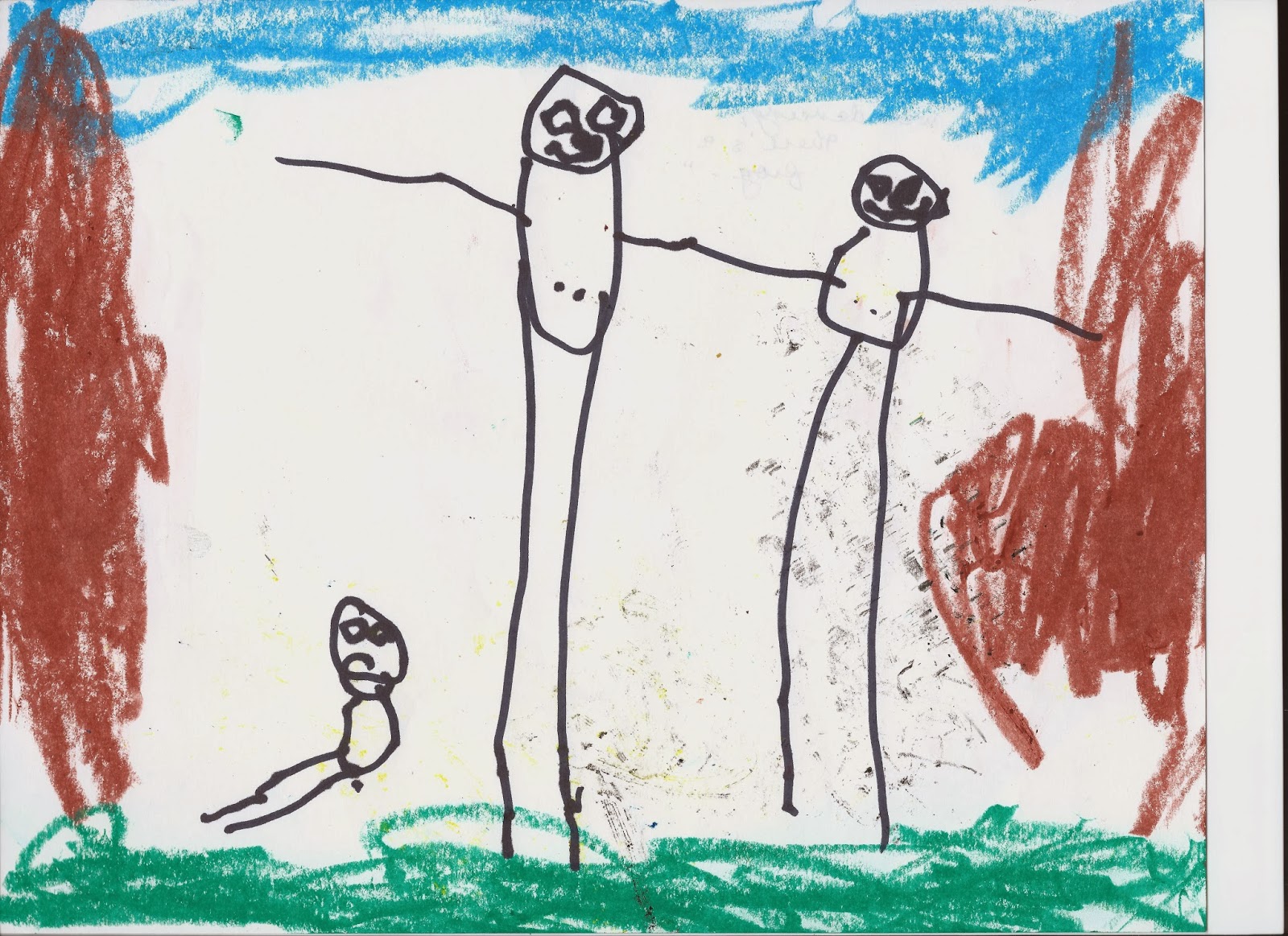
Originally I had planned to have the children make a book to contribute to the library for the other children. I honestly believe they were more prepared to do this after they had explored the story and it's themes through drama. So I gave each of them a scene from the opera story to illustrate, and we used new art material for the illustrations: Sharpies and
Creamy Crayons.
The first step
The first step was for each child to draw what they remembered about the scene they were assigned. The above picture is one girl's favorite: The angels coming from the wings and above to guard the sleeping children in the forest. She chose triangles because "they would be pretty" as angel regalia.
The second step was to use the colors. The above girl chose to color only the angels.
Others put color into their illustrations to represent the set...
"I wanted the ceiling to be blue, the walls brown, and the floor green. It's Hansel and Gretel in their house, and I drew a frog, because I like frogs."
The book will be laminated and bound next week. I will be delighted to share their reactions when it happens!
So how have I proved you can teach everything through a project like this? I can use standards to show how they have been met.
The Virginia Foundation Blocks for Early Learning include standards for visual arts: Create specific works of art based on a common theme, .and: Develop and use fine motor skills necessary to produce two...dimensional works of art. For Language Arts, they list: Use size, shape, color, and spatial words to describe people, places, and things.
I thought that these standards were addressed and then some, so I took a look at the Kindergarten SOL's for visual art and language arts as well: "The student will describe the sequence of steps in making a work of art", and: "The student will comprehend fiction by retelling familiar stories using beginning, middle and end. Also: Discuss characters, setting, and events."
When a teacher uses the arts to teach, standards are met naturally. In fact, standards are exceeded.
Let's revisit the classroom to see what the children decided to do after they had digested the story of Hansel and Gretel thoroughly, acted it out, and made a book out of it. I asked them if they would like to invent their own version of the story. I suggested they add a helicopter, a la
Gianni Rodari, , an idea that tickled them. They took turns speaking, and this was the result.
Once upon a time there was a boy and girl named Hansel and Gretel. They lived in a forest. A helicopter came and took them to another part of the forest. They thought they were at their house but they were at a witch's house. The witch came down in a plane, not wires (like in the opera). Gretel saw something to distract the witch, a tunnel. Gretel freed Hansel and when the witch was coming out of the tunnel they pushed her into the oven. She came out as a witch cupcake! They ate it. Then they danced.
The End.
I think they "got" the idea of stories, don't you?