Showing posts with label curriculum. Show all posts

Sunday, September 7, 2014

Star Moon Drummers: The genesis of a small group name and the importance of rhythm to children.

As most of you know, my first profession was as a singer. I prided myself on being able to read complex rhythms, and to sing them with accuracy. I noticed throughout my career that many singers (and church organists, by the way) did not "get" complex rhythm patterns easily. No need to analyze that phenomenon. I leave it to music educators. But in preschool, rhythm patterns mean much more than most preschool teachers give them credit for.

Last week my small group needed to come up with a name. Children come into this with different ideas, many animals, and increasingly, media favorites. One boy wanted us to be the "minions"! A teacher said that "Gail's Minions" would be pretty cool! But I also knew that this boy had told me he was glad to be in my group because I liked drumming, and so did he. So I prompted him: "Remember you said you like to drum? Want us to be the Drummers?" That did it. Everyone wanted to be The Drummers. The next step was to find our descriptive words. One new boy said, over and over, "STAR!" Several girls said, "MOON!" in response. I was overcome. "What a beautiful name!", I said. "The STAR MOON DRUMMERS!" There was instant buy-in. We are the Star Moon Drummers. We have been drumming and scatting rhythm patterns all week.

Rhythm exploration is math. So providing drumming opportunities are an easy sell in educational circles. Rhythm work is social. The children we teach at our center become so much more organized and cooperative when they drum or use our hammock-style xylophone. Social-emotional skills are the backbone of kindergarten readiness.

Rhythm exploration is science. I hung our xylophone out this week. How may ways can you play one? I had never even thought of some of the experiments the children did. How does it sound if you crawl UNDER the xylophone and play it? How does it sound if you tip the beater back and forth, making it play with both ends? And of course, can I make a "glissando" (my term)? Heck, yes!! I did not suggest any of these alternatives, because the children are natural scientists, experimenting, processing data, coming up with new ideas and making observations. Here are some (albeit headless) photos of our children in action;

Drumming on the Playground

The xylophone is made from bed slats cut from large to small. The sound is not unlike Japanese wood blocks, The drummers soon dragged their drums over to the xylophone so that there was a sort of combo. The xylophone players looked like this...

Xylophone made out of old bed slats.

We look forward to a year of music experimentation. I will introduce videos of street drummers to this group to validate their awesome efforts on the playground. I would LOVE for them to see street drummers in person, to even participate. A field trip? Dancing to each others' drumming? Of course.

We must never underestimate the power of the arts to teach. We must not forget that, as Loris Malaguzzi said so often, in teaching we must do "Nothing without joy".


Sunday, March 30, 2014

Preserving the old, preparing the new.


This is one of the WPA mosaic tiles built into the walls of the North End Pavilion at Spring Lake (NJ) Beach. That pavilion was totally destroyed by Hurricane Sandy. The tiles, we heard, had been removed for safe-keeping before the storm. The new pavilion is an almost exact replica of the old one, which is such a joy to those of us who thought that a new construction would be a new look. Even better, there are replicas of the old tiles in place. To those of us who love the Jersey Shore, this was the right thing to do.

New and original architecture, and new art are good for culture and society. New and original people are, too! Once the WPA employed artists were the breath of fresh air, the innovators, the vanguard of art in the early 20th century. When I think of how the government actually financed them, I feel such pride that the U.S. Government saw employment of artists as equally important as employment of steel workers or machinists. This attitude towards the arts has not been carried along into the new century.

Ironically, teaching through the arts has been shown in research to be the most integrating path to healthy, mature and consistent learning. I find that using the arts as a pathway motivates students to bring all of their own "human capital" to their efforts. Just as those early WPA artists, paid by Uncle Sam, threw their best efforts into working with other craftsmen to produce useful and beautiful buildings, our students will work through the arts to produce beautiful "products" that demonstrate what they have learned. New and original people are the human product of this approach. 

Teaching through arts integration is rigorous. Students must address learning standards in both the arts and in other subjects, such as history, literature, science and math. They use their hands, bodies, voices, feelings AND intellect in the learning process. This is what we call, in the Early Childhood field, integrated curriculum. There are many ways teachers can learn this approach, one being at the Kennedy Center's CETA (Changing Education Through the Arts) program. Becoming a CETA school means getting teaching artists into your building. Wolf Trap also works with schools to train teachers to teach through the arts. There are many online resources ask well. Here is one example of a digital documentation of teaching both visual art and mathematics to kindergartners, and here are examples of lessons for grades 5 through 8 addressing both social studies and language arts.

An old building is not always worth replicating. Certainly old teaching methods aren't, either. We need to teach to the whole person, preserving the best the arts and education have to offer. Let's not ignore this challenge.

Tuesday, March 4, 2014

You say Pigasso, I say Picasso...

I love four year olds! They are in a transition stage of development, at the cusp of separating reality from fantasy. You can see the wheels turning in some of their amazing brains, shifting gears from, "Is this real?" to "Of course it's not real". I can see it when I bring out my puppet, Melvin the Monkey (named after my beloved first voice teacher, Mel Hakola). "He's not talking, YOU are!", they say, at the same time speaking with Melvin directly. "Melvin, do you want a banana?" 

We read When Pigasso Met Mootisse, and I carefully explained that there were real artists named Picasso and Matisse, showing them pictures of the artists and their art. But throughout the subsequent activities related to the story, each time I said the artists' names, they corrected me. One little boy, a concerned look on his face, said, "Gail, you mean Pigasso, right?". I admit I caved. That "G" started creeping into my pronunciation. 

Here is how we did our Pigasso, er, Picasso art project, and the objectives you as an early childhood educator can reference if you do it with children. 

We gathered at morning meeting and listed our choices for activity time, as usual. On the art table Sue had prepared a long mirror down one side of the table so that the children could draw a LARGE circle, eyes, nose and mouth, looking at themselves while they drew, sitting three at a time.. Children, speaking their thoughts aloud, said, "My face is a circle", or "Mine's an oval". Some, remembering the cubism we discussed prior to the activity, said, "I'll make my eyes triangles like a pumpkin". 

The next step was to cut their picture into five largish pieces (these instructions were to prevent the inevitable cutting into shards and iddy-biddy pieces that often happens when we say, "cut"). Sue had demonstrated in morning meeting that pieces of a drawing could be reformed into a "new face", just as Picasso, I mean Pigasso had done. 
We saved the pieces for each child by putting them together with a paper clip with their name attached. The next day they pieced their "new faces" together on a sheet of construction paper of their choosing. After gluing them down, they used my favorite colors, Creamy Crayons, to give vibrant colors to the new faces. As these are children of varying age within the "fours" bracket, not to mention varying individual interests and passions, the result was a broad range of "new faces" to put up in our stair well.


On the subject of directions, which I raised in my last post, we only provided those I have already mentioned except for encouraging children to color pieces so that the idea of a face be preserved. They were left to interpret that direction as they wished. Our direct instruction was not to tight, not to loose. Hopefully, it was just right!

Virginia Visual Arts Foundation Block 1: Visual Communication and Production, all four objectives.
Virginia Visual Arts Foundation Block 2: Art History and Cultural Context, objectives b and c.


Tuesday, January 21, 2014

How to Use an Opera to Teach Nearly Everything--An Integrated Study for Pre-K

I sang with Frederica Von Stade twice at the Washington Opera. I was one of six "spirits" in a wondrous Canadian production of Cendrillon, produced there when I was (ahem) young. Soon after, when I began teaching young children, not knowing that children weren't supposed to be taught about opera, I introduced Von Stade's performance in Humperdinck's Hansel and Gretel from the Metropolitan Opera to my unsuspecting young students. And not knowing that they weren't supposed to understand opera, they fell in love with it. I developed a unit for the opera and the story that included writing, drawing, acting, singing, and what I called "stage magic" (making something appear to be real when it is not).

Fast forward many years and we come to a holiday season when my teaching partner was going to be in her native Australia for three weeks, and I was planning for sixteen rather than eight children. What to do? Duh! Hansel and Gretel, of course!

I introduced the unit with storybooks, like any good unit about a fairy tale. This story in particular isn't devoid of controversy. Teachers routinely caution me about it. "The mother tries to get rid of them. It has a witch. It isn't appropriate for preschool." Well, yes, the mother, or step-mother is a problem. I use at least two versions of the fairy tale, especially Beni Montresor's version.
Signor Montresor created the picture book from the opera's libretto, which has the mother shoo her children out the door to pick wild strawberries in the woods. They get lost and the rest of the story is more or less the same. We also read James Marshall's version, which is comic to adults, but still has the mother trying to lose her kids. We discussed the two stories and I polled them on their favorite one. The children were split. The more nurturing the children, the more they preferred the Montresor. The more exuberant preferred Marshall.

This is when I brainstorm with them about how stories can be told, and introduce the concept of singing a story. Do you want to see the story sung? Well, what do you think they said?

We watched the video of the opera bit by bit over a few days. The children asked many questions as we watched, such as, 1.) Why are the people are always singing?  2.) Is that Hansel a boy or a girl (the role is a "pants role". 3.) Is the witch really flying? (she is in a harness and flies in on wires) 4.) Why is her tongue green? (Let's suck on a green candy to find out about stage magic.) and on and on!

We sang "Brother will you dance with me?". We created a giant cardboard cookie to use to pretend to turn each other into one, like they turn the witch into one in the opera. Then the question came up, one that other classes haven't asked before: "Can we do it as a play?" One boy in particular lobbied to be the witch.

Ah! The emergent curriculum teacher rejoices! "Well, of course!" And so it began.


Gail casting the production.

First we have to agree on who is doing what. It isn't nearly as difficult as you might think. Four and five year olds can be highly motivated and focused when they want to do something together that involves every part of themselves. They easily accept double and triple casting so everyone gets to do the roles they wish to portray. They accept direction (not always true of divas and divos). You don't have to talk to them in high motherese. You can direct them and yet accept  their creative proclivities at the same time. It is a joy, pure and simple.

It helps a teacher to know the opera plot well. There are characters the children adore that aren't in the storybooks, such as the dew fairy and the sandman, or all the enchanted animals portrayed by children in the video of the opera production. They revel in the happy ending, when the mother and father find the children and everyone sings and dances in jubilation (this was their favorite scene to portray, besides tearing up and pretending to eat the gingerbread witch). It is sort of a "Ding Dong, the Witch is Dead", but the music is Wagnerian (Humperdinck was a student of Wagner).

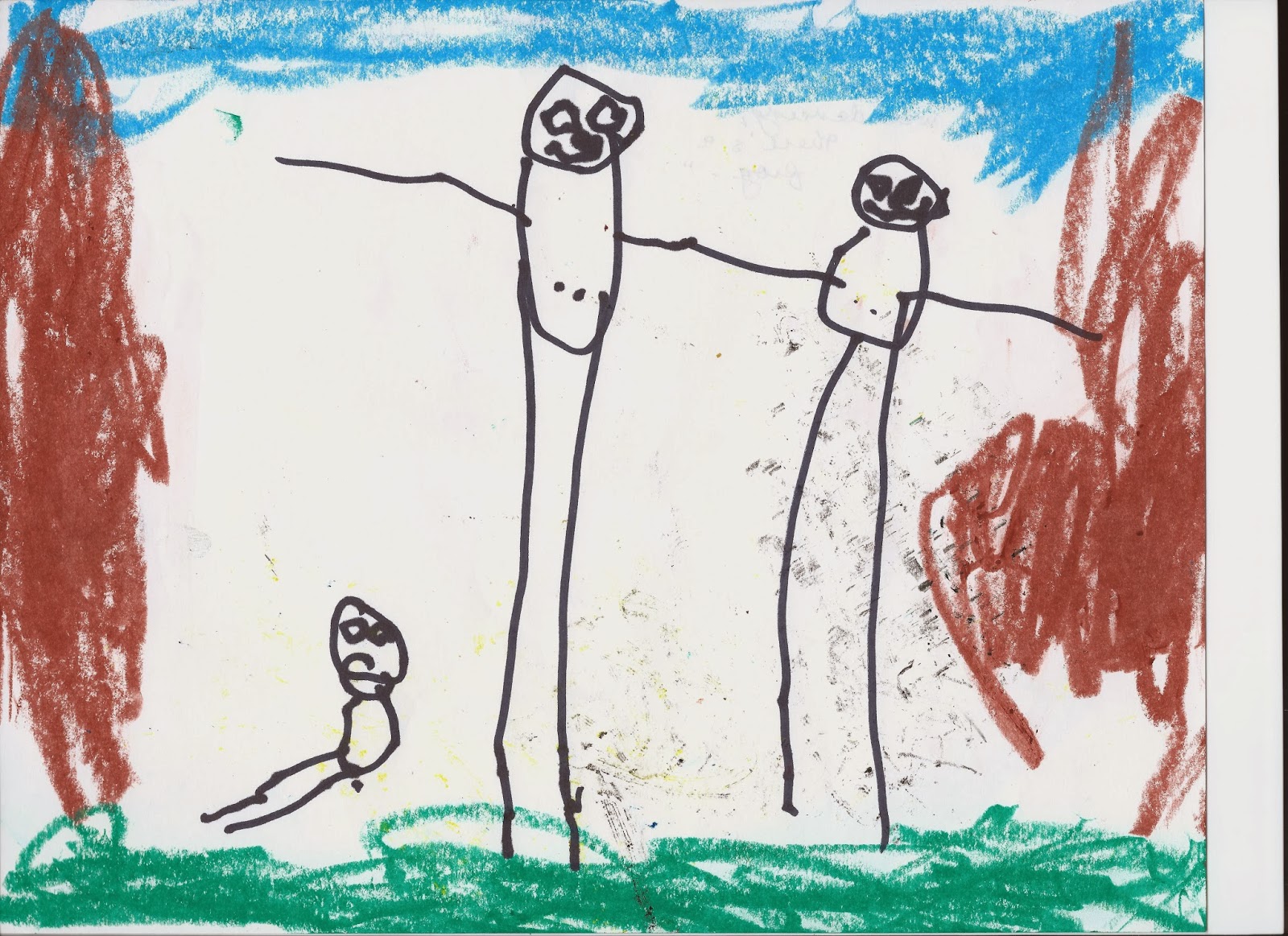
Originally I had planned to have the children make a book to contribute to the library for the other children. I honestly believe they were more prepared to do this after they had explored the story and it's themes through drama. So I gave each of them a scene from the opera story to illustrate, and we used new art material for the illustrations: Sharpies and Creamy Crayons.
The first step

The first step was for each child to draw what they remembered about the scene they were assigned. The above picture is one girl's favorite: The angels coming from the wings and above to guard the sleeping children in the forest. She chose triangles because "they would be pretty" as angel regalia. 

The second step was to use the colors. The above girl chose to color only the angels. 
Others put color into their illustrations to represent the set...

"I wanted the ceiling to be blue, the walls brown, and the floor green. It's Hansel and Gretel in their house, and I drew a frog, because I like frogs." 

The book will be laminated and bound next week. I will be delighted to share their reactions when it happens!

So how have I proved you can teach everything through a project like this? I can use standards to show how they have been met. 

The Virginia Foundation Blocks for Early Learning include standards for visual arts: Create specific works of art based on a common theme, .and: Develop and use fine motor skills necessary to produce two...dimensional works of art. For Language Arts, they list: Use size, shape, color, and spatial words to describe people, places, and things.


I thought that these standards were addressed and then some, so I took a look at the Kindergarten SOL's for visual art and language arts as well: "The student will describe the sequence of steps in making a work of art", and: "The student will comprehend fiction by retelling familiar stories using beginning, middle and end. Also: Discuss characters, setting, and events."
When a teacher uses the arts to teach, standards are met naturally. In fact, standards are exceeded. 

Let's revisit the classroom to see what the children decided to do after they had digested the story of Hansel and Gretel thoroughly, acted it out, and made a book out of it. I asked them if they would like to invent their own version of the story. I suggested they add a helicopter, a la Gianni Rodari, , an idea that tickled them. They took turns speaking, and this was the result.

Once upon a time there was a boy and girl named Hansel and Gretel. They lived in a forest. A  helicopter came and took them to another part of the forest. They thought they were at their house but they were at a witch's house. The witch came down in a plane, not wires (like in the opera). Gretel saw something to distract the witch, a tunnel. Gretel freed Hansel and when the witch was coming out of the tunnel they pushed her into the oven. She came out as a witch cupcake! They ate it. Then they danced. 
The End.

I think they "got" the idea of stories, don't you?


Tuesday, December 10, 2013

How We Went from the Farm to a Phone Booth.

My totally cool colleagues created a phone booth for the children. How did we get to a phone booth? By emergent curriculum and the Project Approach.

Curriculum that emerges out of the interests of children and teachers has been very important to Early Childhood Education, at least in the preschool years when standardized testing has yet to make an appearance. It is a concept carefully explained in a multitude of textbooks from which I teach, and you can find many resources by googling the term. I want to describe a process from my own center, so that its example can be examined by others. Everything that emerges doesn't necessarily have to be extended or studied, but sometimes they are, and they become a project. In this case, a metamorphosizing project.


So how did a dramatic play area be transformed from a farm to a grocery store and then to a grocery store with an old fashioned (British-style) phone booth in it? Was this whimsy? Well,...yes, but read on!

In October we went on our annual field trip to the Potomac Vegetable Farm.. The children enjoyed a hayride, a walk through plantings both common and uncommon (who would have thought Coltsfoot was grown in a vegetable farm, but it is commonly used in stews in England. My teaching partner, Sue, told the children about eating it in wonderful, aromatic stews as a child growing up in Australia. We also ate cherry tomatoes straight off of the vines. Yum!)

The children enjoyed the pigs and hens. One girl almost fell into the pig pen by leaning as far out as she could. She wanted to pet a pig!
We ended with a picnic, and buying vegetables for our afternoon snack table at the center.

The dramatic play area quickly became a farm. The children made vegetables for planting, and used masking tape for rows. No, we did not use plastic vegetables. They are very colorful and fun, but they cut out a step necessary to our approach: The children need to do whatever they can to contribute to the project. We don't magically do it for them. They have ownership, an important part of self-esteem and self-efficacy. Fine motor skills get their due, without artificial activities to practice them.
After a while the farm idea got old. The children didn't play in it anymore and at the same time they began showing an interest in cooking and recipe writing. So...
I put out flower, oatmeal, sugar, salt, spices and water. I told them they needed to "write" a recipe before they cooked. So they drew pictures and invented spelling of the ingredients they wanted in their cooking, and "followed" the recipe on trays. We even put some of the concoctions into little cups, and put them in the fridge to see how they would change. The children predicted results ranging from actual cookies to "mush!". They wanted to cook again and again I decided that they needed to actually do the real thing. With Thanksgiving approaching we decided to make applesauce and pumpkin pudding. Of course they wrote recipes, first! The amazing thing about an emergent curriculum is that writing practice is painless. Children are motivated to use the tools of emergent and developmental writing when they have something they dearly want to do! Each child participates at his or her own level.

Pretend Cooking
Pretend cooking and actual cooking easily introduced the idea of where the crops go from the farm. Children are very much aware of grocery stores and what they can (and sometimes can't) get from them! They began bringing in empty cartons and containers from home. Our amazing teacher, Carrie, made shelving, and they were stocked by the children. We hauled out the toy cash registers. Did we use play money? NO! The children were more than happy to produce money at an alarming rate, and much of it had numbers on it (Ah ha! There's that emergent math!). They learned through trial and error that the money needed to fit the cash register drawers so they began cutting it down. All the while they were shopping and checking people out, taking their food "home" to the library and the loft. Social skills were tested through negotiating who would be checkers and who would shop. I suggested creating a crew of "Night Stockers" but that was voted down by my colleagues. The children never see the night stockers. They aren't a part of their shopping experience.

Which brings us to the phone booth...

When I was little, every grocery store had some form of public phone either inside or out. In Australia, Sue says there are still red, British-style phone booths. Phone booths are a part of our childhood memories, not of our students'. But we described them, each in turn, to the children, emphasizing that, once upon a time, people didn't carry phones in their pockets! There were public phones and people actually stood in line to use them. The children were entranced.

So Carrie and Sue made one out of cardboard, plastic, paint and duct tape. And the children began lining up to use it. It was and is a delight for all of us.

So here it is, a documentation of a series of projects and activities that emerged through the day to day life of a multi-age classroom of three and four year olds. I didn't even mention the books we read as part of our work with the children, but there were many. There was probably more we could have done. But having done this much has been a joy for everyone. And the emergence of curriculum will doubtless continue.