Showing posts with label arts integration. Show all posts

Sunday, October 30, 2016

Visual art as play: Integrating the arts into the curriculum.


We read When Pigasso Met Mootisse, by Nina Laden, again this year. Each class responds with intense interest and curiosity when I read this story to them. No one is indifferent! But this year, I continued with actual stories about the artists lives. I read, Henri's Scissors, by Jeannette Winter, and Just Behave, Picasso!, by Jonah Winter, and illustrated by Kevin Hawkes. These two books were labeled ages eight and up, so I was risking inattention and much silly behavior by reading them to a group of sixteen fours!

I was surprised and happy by their response to each book. The first book is a very true story about Matisse's shift to paper cutouts as his art. The theme included his old age and death. When I got to that part of the story there was a reverent hush among the children. "He died?", was a question. "Yes", I answered. "He was very old...", was one comment. The illustrator shows Matisse cutting out the stars in heaven, and the children accepted this premise.

The Picasso book emphasizes the wide expansiveness of self-expression in art, and how Picasso changed his art as his need to express himself changed. The children were mesmerized by the idea that, even though people said Picasso should "behave", he didn't.  One boy said, "Your art is for you! Nobody else can tell you how to do your art". That was the meaning of the book for him. Others were interested in finding the representational meaning of cubist paintings.

The children have begun following their muses, now. Some are drawing with "shapes", their take on cubism. Others are cutting paper and gluing it down. Because we need a school auction project, we will see where this takes us. I have materials at the ready! My take away from this experience is that even preschool children are grabbed by "big ideas". I forget sometimes. Never underestimate their ability to absorb meaning from their reading. Nothing I did during these readings and activities were "cute". They didn't need to be.

Here are a few pictures of preliminary experimentation before the auction project begins...

"Shape drawing"


Cutting shapes for bigger work


Saturday, June 13, 2015

Dramatic Play: How it can hold everything together.

Children were building castles in the block corner, explaining the different areas by using terms such as "great room", and "battlements" (we had been reading castle books to them). My small group had just finished a long project on bridges, and drawbridges came up in conversation. For teachers who believe in emergent, project-oriented learning, these facts were like a blinking neon sign that said, 

Hint...Hint...Hint!!!

Coincidentally, the Dramatic Play area was due for a changeover. I have been giving workshops called "Projects and Provocations", which were heavily influenced by the Reggio approach. Some teachers from other preschools dropped their jaws when I told them that dramatic play needn't always be a house corner, or that it could be changed over when their students' interest lagged. I thought of them when Carrie (a gifted teacher at our center) and I changed the area into the Great Room of a castle. 

Fireplace in Great Room
The fireplace was especially fun. While we created the mantel and chimney, the children used various artistic media to create a stone-like surface. I brought in electric candles for the table, and found that Carrie's group had decided, when I had been on the playground, to put them in the fireplace for a more authentic effect.

The morning "question of the day" for parents with their incoming children was this one:
Question of the Day
Having had multiple time-travel stories about Medieval times read to them, children were very clear about what they liked and disliked about the idea of living then. 
Battlements best. No cannons worst!
For one girl, the worst was "war". Seige was a part of every story about castles.

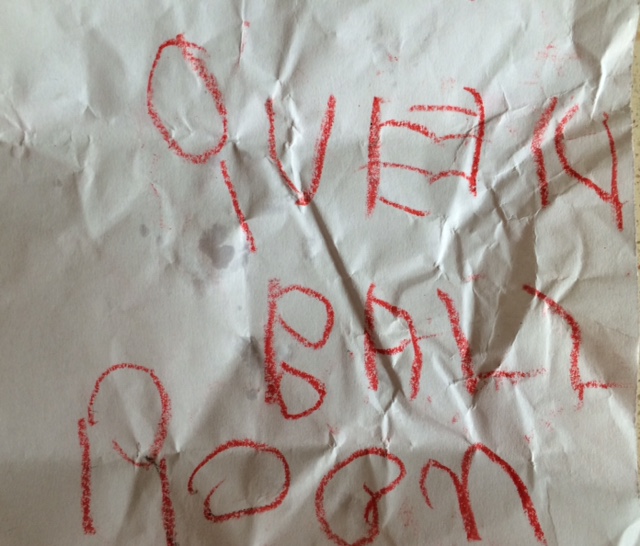
In the writing center we left rolled up pieces of paper for "scrolls". When children wrote on them and brought them to a teacher to "read", hilarity ensued. "By this proclamation, all teachers will leave and go to Starbucks. Children are in charge of the school!" Many invitations to "balls" were issued:
Queen Ball Room
Musicians were in the castle books, too, so I downloaded music from iTunes appropriate to the era. The children brought drums to the great room, and I played the music for them. 
Girls drumming to "Music of the Crusades"

Then one morning, a boy spoke words dear to my heart: "Let's make our own castle, Gail". So my small group began working on a castle model, made of corrugated cardboard, tubes, and pieces of shoeboxes. We are still working on it, because one thing led to another, as is the way of projects. They made a moat (and we had learned that moats were NOT clean!), battlements, a dungeon, a kitchen with a fireplace and chimney cut through the roof ("Gail, we need a hole in the roof for the smoke to get out"). A "keep" was created by including another shoebox. 
Castle with moat, drawbridge, and Keep.
Of course the children wanted to create little knights and princesses. I pointed out that those lovely people were not the most important people in the castle. Without the cooks, farmers, and others who produced food, the royalty would have starved. Immediately one boy created a cook for the kitchen.

I have been so pleased with the depth of learning that has taken place throughout this project, aka. "unit". The children have been fascinated by the topic, we integrated science, social studies, math, and language arts easily without doing rote practice drills. This is the beauty of integrated teaching and learning. I wish it for every child.


Sunday, March 30, 2014

Preserving the old, preparing the new.


This is one of the WPA mosaic tiles built into the walls of the North End Pavilion at Spring Lake (NJ) Beach. That pavilion was totally destroyed by Hurricane Sandy. The tiles, we heard, had been removed for safe-keeping before the storm. The new pavilion is an almost exact replica of the old one, which is such a joy to those of us who thought that a new construction would be a new look. Even better, there are replicas of the old tiles in place. To those of us who love the Jersey Shore, this was the right thing to do.

New and original architecture, and new art are good for culture and society. New and original people are, too! Once the WPA employed artists were the breath of fresh air, the innovators, the vanguard of art in the early 20th century. When I think of how the government actually financed them, I feel such pride that the U.S. Government saw employment of artists as equally important as employment of steel workers or machinists. This attitude towards the arts has not been carried along into the new century.

Ironically, teaching through the arts has been shown in research to be the most integrating path to healthy, mature and consistent learning. I find that using the arts as a pathway motivates students to bring all of their own "human capital" to their efforts. Just as those early WPA artists, paid by Uncle Sam, threw their best efforts into working with other craftsmen to produce useful and beautiful buildings, our students will work through the arts to produce beautiful "products" that demonstrate what they have learned. New and original people are the human product of this approach. 

Teaching through arts integration is rigorous. Students must address learning standards in both the arts and in other subjects, such as history, literature, science and math. They use their hands, bodies, voices, feelings AND intellect in the learning process. This is what we call, in the Early Childhood field, integrated curriculum. There are many ways teachers can learn this approach, one being at the Kennedy Center's CETA (Changing Education Through the Arts) program. Becoming a CETA school means getting teaching artists into your building. Wolf Trap also works with schools to train teachers to teach through the arts. There are many online resources ask well. Here is one example of a digital documentation of teaching both visual art and mathematics to kindergartners, and here are examples of lessons for grades 5 through 8 addressing both social studies and language arts.

An old building is not always worth replicating. Certainly old teaching methods aren't, either. We need to teach to the whole person, preserving the best the arts and education have to offer. Let's not ignore this challenge.

Tuesday, March 4, 2014

You say Pigasso, I say Picasso...

I love four year olds! They are in a transition stage of development, at the cusp of separating reality from fantasy. You can see the wheels turning in some of their amazing brains, shifting gears from, "Is this real?" to "Of course it's not real". I can see it when I bring out my puppet, Melvin the Monkey (named after my beloved first voice teacher, Mel Hakola). "He's not talking, YOU are!", they say, at the same time speaking with Melvin directly. "Melvin, do you want a banana?" 

We read When Pigasso Met Mootisse, and I carefully explained that there were real artists named Picasso and Matisse, showing them pictures of the artists and their art. But throughout the subsequent activities related to the story, each time I said the artists' names, they corrected me. One little boy, a concerned look on his face, said, "Gail, you mean Pigasso, right?". I admit I caved. That "G" started creeping into my pronunciation. 

Here is how we did our Pigasso, er, Picasso art project, and the objectives you as an early childhood educator can reference if you do it with children. 

We gathered at morning meeting and listed our choices for activity time, as usual. On the art table Sue had prepared a long mirror down one side of the table so that the children could draw a LARGE circle, eyes, nose and mouth, looking at themselves while they drew, sitting three at a time.. Children, speaking their thoughts aloud, said, "My face is a circle", or "Mine's an oval". Some, remembering the cubism we discussed prior to the activity, said, "I'll make my eyes triangles like a pumpkin". 

The next step was to cut their picture into five largish pieces (these instructions were to prevent the inevitable cutting into shards and iddy-biddy pieces that often happens when we say, "cut"). Sue had demonstrated in morning meeting that pieces of a drawing could be reformed into a "new face", just as Picasso, I mean Pigasso had done. 
We saved the pieces for each child by putting them together with a paper clip with their name attached. The next day they pieced their "new faces" together on a sheet of construction paper of their choosing. After gluing them down, they used my favorite colors, Creamy Crayons, to give vibrant colors to the new faces. As these are children of varying age within the "fours" bracket, not to mention varying individual interests and passions, the result was a broad range of "new faces" to put up in our stair well.


On the subject of directions, which I raised in my last post, we only provided those I have already mentioned except for encouraging children to color pieces so that the idea of a face be preserved. They were left to interpret that direction as they wished. Our direct instruction was not to tight, not to loose. Hopefully, it was just right!

Virginia Visual Arts Foundation Block 1: Visual Communication and Production, all four objectives.
Virginia Visual Arts Foundation Block 2: Art History and Cultural Context, objectives b and c.