Showing posts with label young children. Show all posts

Saturday, June 13, 2015

Dramatic Play: How it can hold everything together.

Children were building castles in the block corner, explaining the different areas by using terms such as "great room", and "battlements" (we had been reading castle books to them). My small group had just finished a long project on bridges, and drawbridges came up in conversation. For teachers who believe in emergent, project-oriented learning, these facts were like a blinking neon sign that said, 

Hint...Hint...Hint!!!

Coincidentally, the Dramatic Play area was due for a changeover. I have been giving workshops called "Projects and Provocations", which were heavily influenced by the Reggio approach. Some teachers from other preschools dropped their jaws when I told them that dramatic play needn't always be a house corner, or that it could be changed over when their students' interest lagged. I thought of them when Carrie (a gifted teacher at our center) and I changed the area into the Great Room of a castle. 

Fireplace in Great Room
The fireplace was especially fun. While we created the mantel and chimney, the children used various artistic media to create a stone-like surface. I brought in electric candles for the table, and found that Carrie's group had decided, when I had been on the playground, to put them in the fireplace for a more authentic effect.

The morning "question of the day" for parents with their incoming children was this one:
Question of the Day
Having had multiple time-travel stories about Medieval times read to them, children were very clear about what they liked and disliked about the idea of living then. 
Battlements best. No cannons worst!
For one girl, the worst was "war". Seige was a part of every story about castles.

In the writing center we left rolled up pieces of paper for "scrolls". When children wrote on them and brought them to a teacher to "read", hilarity ensued. "By this proclamation, all teachers will leave and go to Starbucks. Children are in charge of the school!" Many invitations to "balls" were issued:
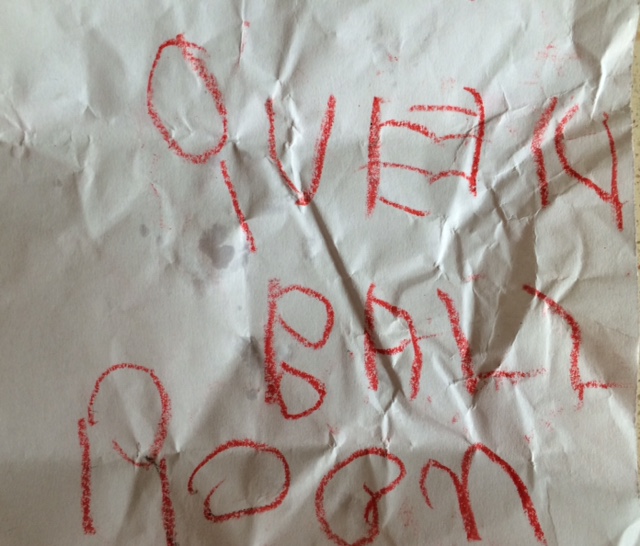
Queen Ball Room
Musicians were in the castle books, too, so I downloaded music from iTunes appropriate to the era. The children brought drums to the great room, and I played the music for them. 
Girls drumming to "Music of the Crusades"

Then one morning, a boy spoke words dear to my heart: "Let's make our own castle, Gail". So my small group began working on a castle model, made of corrugated cardboard, tubes, and pieces of shoeboxes. We are still working on it, because one thing led to another, as is the way of projects. They made a moat (and we had learned that moats were NOT clean!), battlements, a dungeon, a kitchen with a fireplace and chimney cut through the roof ("Gail, we need a hole in the roof for the smoke to get out"). A "keep" was created by including another shoebox. 
Castle with moat, drawbridge, and Keep.
Of course the children wanted to create little knights and princesses. I pointed out that those lovely people were not the most important people in the castle. Without the cooks, farmers, and others who produced food, the royalty would have starved. Immediately one boy created a cook for the kitchen.

I have been so pleased with the depth of learning that has taken place throughout this project, aka. "unit". The children have been fascinated by the topic, we integrated science, social studies, math, and language arts easily without doing rote practice drills. This is the beauty of integrated teaching and learning. I wish it for every child.


Sunday, May 10, 2015

Parents: If you aren't angry, you aren't paying attention!

On the left is an example of an "arts" activity in any classroom for young children. If you find your child is bringing home these pre-cut, adult-directed gems you should bring them back to school with this question: What the heck is this teaching my child?

The teacher might say that the class is studying bugs. She/he might say she is teaching the skill of "following directions". She might also say, "I've been doing this activity for fifty-eight years and it has always been a success. Kids love it.

Ahem.

Where do I begin?

I recently finished teaching a course called Art, Music and Movement for Young Children. My emphasis is on integrated curriculum: Teaching the arts and teaching content in a kind of beautiful soup of connectivity. There is so much to learn. Art forms, techniques, terminology, standards in both the arts and the content areas. The students need to learn the stages of children's creative development. and the stages of social play, so that they can plan appropriate activities and units for each age. I find that I fall short every semester. I know I could have done more to communicate all that needs to be learned.

The final course project is two activities that teach math, science, social studies or language arts through and with the arts fields of music, drama, movement, and visual art. Each activity needs to emphasize an arts field and a content area. It is a hard assignment. I look for the ability of the children involved to make intelligent choices. According to many of my adult students, who seldom have seen the arts as anything other than a frill, their view radically changes (or they say it does) about teaching through the arts. 

Why do I begin with the example above? A student changed this idea to "make it more creative" by giving children pre-cut circles of differing colors. They had a choice, then. The children still had to conform to a model, and couldn't try out different ideas of how to demonstrate their knowledge of bugs (ladybugs are not the only bugs on the planet--I have child students who like ants quite a bunch). Why not look at bugs in paintings? Why not give them different materials, and ask them which bug they are choosing to create? 

Why not? Aww, but look at that ladybug! It's so cute!

Don't fall for it, parents! It's a trap made of decades of busywork cuteness in preschools across the country. It is lazy teaching. Tell the teacher that you will be assessing your child's knowledge, and looking for real creative projects. Tell her/him that you value creativity and honest intellectual inquiry from now on. Take charge of your child's learning.

Wednesday, September 17, 2014

Stories and Child Development: A Happy Marriage!


How do stories and child development intersect? 

Reading stories to children is often recommended to parents as a way to encourage later literacy. It also promotes healthy emotional development through the sharing of special time with parents. A parent reading provides terrific role-modeling for children--"my Dad/Mom reads! I will, too, when I'm bigger!"

Parents and grandparents telling stories should also be encouraged. Nothing in my early life do I remember more fondly, and with more enjoyment, than the stories my Greek grandfather, a survivor of Turkish genocide, told me about his early life as a boy in Asia Minor. The stories were always about a young boy who braved dangers all alone while running between towns selling goods for his father. Wolves, bulls, bears were all easily defeated by my grandfather's trusty knife. I thought he was the most amazing man who ever lived. In adulthood I learned that a Greek grandfather traditionally has a similar array of stories that he tells to his grandchildren--none of them true!  This influenced my teaching practice. I tell stories as well as read them. Some of them are even true!

The story language children hear from adults enriches their literacy. It gives them a structure that lodges inside their hearts and minds, helping them comprehend how a story works, Not only does it have a beginning, middle, end, or who, what, when, where, why. A story has a sense of conflict, and resolution of conflict. These are literacy conventions taught in elementary school. Children also learn about how others solve their problems, how other humans see reality and each other. Stories heard together bind children to each other and create a shared context for future discussions, or future stories.

When children go to kindergarten how many of them have created stories already? I don't mean captions on pictures, or vignettes. I mean progressively more complex and sophisticated stories that interest and entertain their peers? Vivian Paley, the most deservedly revered teacher/researcher/story teller in recent years, wrote about children writing their own stories and then acting them out. I have done this with young children for many years. I ask them to illustrate their stories as well, and we post them for all parents to see when they come to pick them up.

When I read children's stories aloud to the whole group, the look of pride and confidence in the eyes of the author is worth the price of admission. They glow.

Today I experimented with a new (for me) technique. See if you think this would work for you...

We bathroom after both outside times at our center. One of us usually reads to those who are waiting their turn. But each time we go to sit for stories some children scramble to sit in the teachers chair. Today I asked, "I notice that someone always wants to sit in the teacher's chair. Why do you think that happens?" One boy responded, "Maybe we want to tell stories". So I made a list of the children, checking them off one by one, as they came to sit on the teacher's chair and tell a story. Any story, but originals preferred. As each child came to sit and tell a short story, the children listened respectfully, with minimal horsing around (they ARE four). Spontaneously they began to applaud.

Development of social, emotional, and language skills is an important part of this practice. But what is more important to me is the development of a shared sense of community. As they say in Reggio, which I've written about earlier in this blog, everyone is a protagonist. Everyone is their own story, and their stories connect with each other.

Thursday, August 1, 2013

Learning to learn

A month and a half later, we are sitting in morning meeting, and I show our group a flyer from the Washington Opera's coming 2013-2014 season. On the front there is a color picture of the three ladies from Magic Flute confronting the (two-headed!) dragon over the fainted body of Tamino. I show this flyer to our children and they exclaim in joy--"Magic Flute! Look at that dragon!". A visiting former student asks, "Is he dead?". A student patiently  explains, "He's the prince Tamino". Another: "He fainted when the dragon came." They begin reminiscing about the performance, and who was whom, leaving the visitor baffled. She had never heard of this story that our four/five year old children know so intimately and recount with such enjoyment. And she is almost seven! 

I have written about the benefits of the project approach, and about how music connects with language in the brain to form richer concepts, and improve long term memory. But what about what I consider to be the dirty little secret in early childhood education? Many practitioners do not know how to or want to share the realms of art with young children because they themselves do not feel comfortable with them (the realms, that is). My adult students are usually enthusiastic about learning new ways to provide arts experiences, but many teachers have difficulty envisioning going beyond the traditional format of providing pre-cut pieces of paper or even coloring sheets to cut out and form scenes or stick puppets, or other "art". Thinking outside the box is possible but going there? Maybe not. Using classical music is considered great for "calming" children but giving them the experience of music and drama? Maybe not. If teachers think that learning about new children's authors is exciting and fun, they do not always think so about learning to appreciate opera and ballet. Yet young children are so drawn to these forms of art when the teacher is also open and enthusiastic about them.

What is needed is training that demonstrates to teachers that they can learn about anything new (as they expect their students to). Just as they learn about sea life to teach about it, they can learn about Mozart (start with Mozart's Magic Fantasy). They can explore Wikipedia and YouTube. They can talk to friends who are familiar with these theater arts and ask questions. Just as children ask questions to learn, so can we, the "big kids" who teach them. The teacher's brain must continue to make connections in order to be fresh and open to everything children can learn. And they must not underestimate their own ability to learn, anymore than they do their students'.