Showing posts with label reggio. Show all posts

Saturday, June 13, 2015

Dramatic Play: How it can hold everything together.

Children were building castles in the block corner, explaining the different areas by using terms such as "great room", and "battlements" (we had been reading castle books to them). My small group had just finished a long project on bridges, and drawbridges came up in conversation. For teachers who believe in emergent, project-oriented learning, these facts were like a blinking neon sign that said, 

Hint...Hint...Hint!!!

Coincidentally, the Dramatic Play area was due for a changeover. I have been giving workshops called "Projects and Provocations", which were heavily influenced by the Reggio approach. Some teachers from other preschools dropped their jaws when I told them that dramatic play needn't always be a house corner, or that it could be changed over when their students' interest lagged. I thought of them when Carrie (a gifted teacher at our center) and I changed the area into the Great Room of a castle. 

Fireplace in Great Room
The fireplace was especially fun. While we created the mantel and chimney, the children used various artistic media to create a stone-like surface. I brought in electric candles for the table, and found that Carrie's group had decided, when I had been on the playground, to put them in the fireplace for a more authentic effect.

The morning "question of the day" for parents with their incoming children was this one:
Question of the Day
Having had multiple time-travel stories about Medieval times read to them, children were very clear about what they liked and disliked about the idea of living then. 
Battlements best. No cannons worst!
For one girl, the worst was "war". Seige was a part of every story about castles.

In the writing center we left rolled up pieces of paper for "scrolls". When children wrote on them and brought them to a teacher to "read", hilarity ensued. "By this proclamation, all teachers will leave and go to Starbucks. Children are in charge of the school!" Many invitations to "balls" were issued:
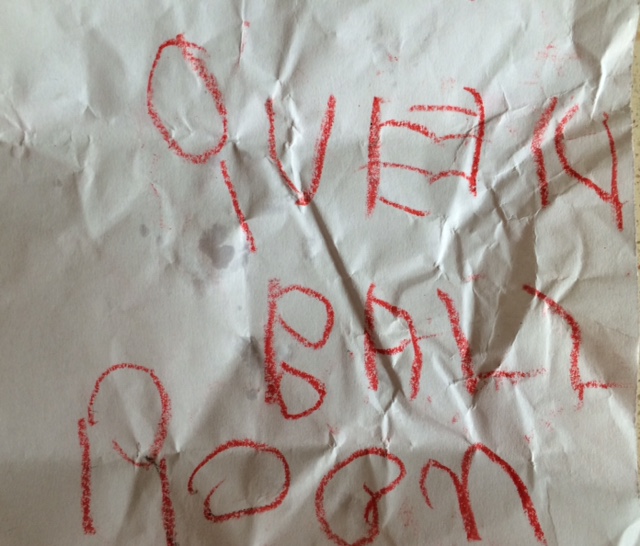
Queen Ball Room
Musicians were in the castle books, too, so I downloaded music from iTunes appropriate to the era. The children brought drums to the great room, and I played the music for them. 
Girls drumming to "Music of the Crusades"

Then one morning, a boy spoke words dear to my heart: "Let's make our own castle, Gail". So my small group began working on a castle model, made of corrugated cardboard, tubes, and pieces of shoeboxes. We are still working on it, because one thing led to another, as is the way of projects. They made a moat (and we had learned that moats were NOT clean!), battlements, a dungeon, a kitchen with a fireplace and chimney cut through the roof ("Gail, we need a hole in the roof for the smoke to get out"). A "keep" was created by including another shoebox. 
Castle with moat, drawbridge, and Keep.
Of course the children wanted to create little knights and princesses. I pointed out that those lovely people were not the most important people in the castle. Without the cooks, farmers, and others who produced food, the royalty would have starved. Immediately one boy created a cook for the kitchen.

I have been so pleased with the depth of learning that has taken place throughout this project, aka. "unit". The children have been fascinated by the topic, we integrated science, social studies, math, and language arts easily without doing rote practice drills. This is the beauty of integrated teaching and learning. I wish it for every child.


Sunday, January 25, 2015

Play: Learning in Motion


I read in the Washington Post today about a preschool classroom in Arlington.  In the column, the teacher, Launa Hall, describes her struggles to teach reading skills to preschoolers while feeling guilty about not being able to allow them to play. The Pre-K standards she uses are doable in a play environment, but the mandated curriculum in which they are delivered, as we say in the trade, are not developmentally appropriate. The joy of childhood is a secondary characteristic, not a primary one, in public Pre-K programs. 

In our program, children are given multiple opportunities to construct their own knowledge. During our early morning, late afternoon, and outside times, when we set the environment for learning, they do just that! 

New York City

The picture above is New York City. Several children have been to New York recently, and, have parents who talk WITH their children, rather than down TO them. They come back to school with a fund of knowledge that flashcards and lesson books can't teach. If you look hard enough, you will see the Port Authority, and the Empire State Building. The builders were inspired by each other, and as an impromptu small group demonstrated their knowledge in the block corner. This whole enterprise was preceded by a flurry of drafting in the drawing/writing center. 

Design Team 

Our modeling of drawing, planning, and building all year contributed to this project, but the children did it on their own.

Hayride
We went on a hayride in October but children are still conspiring to create their own. These girls asked me for rope, but I didn't have any. I was at a loss on how to help them, but one of them "got an idea" and organized a committee to create a "hayride" out of a wagon, scooter and tricycle. They did it themselves, based on their own past experience playing on our playground, and interacting with us and other children.

After the snow, children wanted to create "plows". Here is a picture of their idea:

Snow Plows
The boy on the left has worked out that a Tonka truck with a tire and a seat on it, pushing a shovel, makes an admirable snow plow. The boy on the right is using his friend's idea to make his own plow. Children learn from each other, as well as from adults. Vygotsky explained this many years ago. The children learn within a social network. That network includes each other as well as their teachers! 

Our program is alive with discovery and design. Interactions with adults are frequent, and powerful,but not coercive.We "teach" through setting the stage, following the learners and enabling their ideas with materials and methods. A program for preschoolers needs to be rich in materials, ideas, and loving interactions with knowledgeable adults.Those adults must, daily, discuss among themselves where and how the children are going with their learning, knowing that math, language and science are inherent in children's interests. The children are on their own developmental train riding into the future. We need to climb aboard. 


Sunday, November 23, 2014

The Challenge of Behavior: When it is Out of Bounds


I write about how the arts enhance early learning, and in fact, must be central to it. That's my thing and I don't mean to veer from that theme. But there is a huge issue in early care that trumps all others: Challenging Behavior. In an arts-based, project-oriented center or classroom there should be ample opportunity for children to be wholly engaged in learning to the point that they themselves can be authors of the curriculum. In Reggio-inspired centers, the children know they are protagonists in the theater of learning. They are welcome to contribute ideas, and to even critique teacher decisions. This happens where I teach. It certainly keeps the teachers on their toes. No overused, tired themes and units for us! Our children are invested in everything that goes on in our little world.

Challenging behavior happens everywhere, even in the best of programs and centers. Defining it isn't really hard. Behavior that is annoying to teachers but developmentally appropriate and is even a welcome sign of maturing isn't what I'm talking about here. All fours are silly, potty-mouthed little beings. All fours are physically exuberant. If you as a teacher expect perfect behavior your are in the wrong profession. But there are children who go beyond the "norm". Those children who hinder the rest of the learners, and themselves by attention-seeking, even violent behavior that seems unpredictable and dangerous. These children are the ones who, still, are the most expelled individuals in education. 

In a center that prides itself on never expelling a child, such a ours, it is imperative to have both a uniform expectation for children's prosocial behavior, and the means to teach this behavior. Teachers meet to discuss learning progress and social-emotional issues, as well as evolving curriculum, every day. Planned, continuing observations inform discussions about what strategies to use to manage behavior, and to teach self-management, without the use of external rewards such as stickers and other non-relevant rewards. These rewards backfire when children cease to be interested in stickers, or up the ante by demanding better rewards, in order for them to be interested in prosocial behavior! If a chart is used, the child must be a part of the planning for the way it is used, and what the achievement will be when the chart is filled with his or her own check marks. "Rewards" must be meaningful to the child. 

The next step is referral. In the article cited above, mental health referrals are recommended. After you document behavior over time, parents need to be given choices for referrals. Presumably, you have already conferenced quite a bit about their child's learning, and its interruption by anti-social behavior (but don't call it that!). Child Find is also a good resource, if you believe that some developmental delay is involved. It's free, too. Make sure that your center submits a referral in conjunction with the parents, so that the experts don't assume that the parents aren't cognizant of behavior that is age-appropriate. It is also important for the center or school to refer so that the behavior isn't minimized, as parents so often say things like, "Well, she hardly ever does that at home...".

I didn't start this post thinking I was going to write a "how-to refer" piece! What I wanted to especially mention is that childcare centers, even the best of them, can be difficult places for many children. Walking in line, at any age, is purely for the convenience of the school or center. When do adults walk in a line? We "get good" at it in school, if we are lucky, then never use the skill again, unless we join the armed services. When I am at my best I sing us along the way. I try to give the children a sense of communal belonging and shared intent. We do "silly walks", or play "follow the leader". During transitions, when children are waiting to go outside with their coats and hats on, we read or play games until the last child is ready. Our newest intellectual game has been integrating the lines:                                                                                                                                                          
Numbers for lining up.


Children line up in two lines, one odd, the other even. We go down the stairs in two lines and then the children integrate themselves into one line, number order, all by themselves. We  have a list of names and numbers in case someone forgets (they do, of course). This exercise gives them ownership of the process, they each have their own place in the line, which changes every day. The first thing the children do when either Sue or I come in is ask, "Did you change the numbers?". They are fully invested. This is integrated curriculum. Math skills play alongside social skills and give each child his or her own place to "own". I recommend it for Pre-K and over.

But for the "out of bound" child, more is needed. Special strategies are a must, and referrals are necessary. For this you need experienced, well-trained teachers, and an administration that is committed to keeping all of the "friends" in the group. Let me know what you think about this issue.