Showing posts with label early literacy. Show all posts

Saturday, March 7, 2015

Integrating Curriculum: Sometimes Learning is Messy!


This is a display of our Imaginary Land Project. It grew out of several strands from previous weeks. My small group (The Star Moon Drummers!--Great name for a rock band, no?) was fascinated by bridges and bridge building. The Drummers (four girls, four boys) built bridges from cardboard, huge wooden blocks, small wooden blocks, and their own bodies. They created stories about their bridges, and associated their understandings with actual bridges they knew or had heard about. One boy was so entranced that he became the expert on suspension bridges, and, with his scientist father, built them in his own basement, sharing pictures with the other children.

Out of a curricular strand on maps that we shared with the other Pre-K small group (The Runaway Missing Names--it's a long story...) came an interest in the ubiquitous world maps we teachers brought in from Doctors Without Borders (bless 'em). I cut the maps I had into quarters and gave each child a piece. I asked them to outline the countries, and as we did, we discussed them, and the children's knowledge of them ("John is from Australia! Senka is from India! Remember Irini from Greece?"). They knew that, on a map, white equaled ice and snow, and blue indicated water, so their interest was piqued by the colors of the continents and countries they outlined. Next, they glued their maps to larger paper and created art by coloring areas with Creamy Crayons. As they colored I asked them to imagine their own country, or "land". I recorded their ideas on my trusty phone, and later typed them up for display. The children sounded out the names of their lands and wrote them on their maps. But that wasn't the end.

Children are most comfortable realizing their vision in three dimensions. This is why so many learning materials in preschool are blocks, math manipulatives, and clay. Just emerging from the sensory-motor stage of development, and not yet at ease with two-D representation, children think, and represent in 3-D. Using bodies in movement is another 3-D, kinesthetic route for cognitive growth. Yes, movement is a form of thought. Howard Gardner's theory of multiple intelligences has been around for years, yet schools still seem to push 2-D thinking as the gold standard. 

How could we represent our imaginary lands in three dimensions? With ice, dirt, greenery, and desert? First the children painted huge cardboard, scavenged from old boxes, in blues and greens. This was the water their lands would inhabit. Then they made their own clay from a recipe in Mudworks, a book I have used for centuries (well..a long time, anyway). They enjoyed the clay-making, because children love messes, and this is a messy activity! They created paper outlines of the land they wanted to create, and chose either one continent or several islands to portray. They laid out the outlines on their clay and cut around them with plastic knives. The land masses were glued to their cardboard oceans with Tacky Glue. 

Next was painting the land according to their own ideas of where in the world their land was. Was it near the equator, or perhaps in temperate zones? Was it near one of the poles? We used a globe to imagine this. Being fours and fives, though, they wanted some of each, so many of their land masses were a combination of brown, green, and white. Their ideas of their lands altered as they created their three-dimensional displays. Ice came into their stories that had none before.

We caucused about what they wanted to build, and with what. My suspension bridge boy had heard of building with sugar cubes and there was no doubt after that what the building medium would be! The children built bridges across water, and buildings on land with sugar cubes, tiny sticks and Tacky Glue. The last step was painting buildings and bridges. Voila! They were done. I asked if they wanted to make sugar people, and to my disappointment, they did not. C'est la vie. The project was theirs, not mine!

Within a group of eight children ages 4 1/2 through 5 1/4 there are many differing talents and abilities. One child might build like an engineer and another tell a fabulous story. Each child needs a different level of support throughout the process. This whole project took several weeks, and at various stages I had another well-trained adult working with us. Children cried at times with frustration because their ability didn't match their vision. We worked with them to come as close as possible. The children were proud of their work, and eager to take their creations home. I took pictures for my 2-D wall display. 

It is indicative of emergent, project-based teaching that boundaries between what is art, language arts, social studies, science, math and other subjects get blurry. That's why parents and some teachers may see an integrated curriculum as just too messy for "real" school. But every child gets individual attention and validation for their thinking and efforts.

Here is one imaginary land story for you to enjoy: "Once upon a time there was a Color Man. He makes crayons and colors. He gives them out to people. He goes on the line (map boundary) to take colors to everyone. He goes to different countries to give colors out."
This is a land I would love to visit. Wouldn't you?


Sunday, January 25, 2015

Play: Learning in Motion


I read in the Washington Post today about a preschool classroom in Arlington.  In the column, the teacher, Launa Hall, describes her struggles to teach reading skills to preschoolers while feeling guilty about not being able to allow them to play. The Pre-K standards she uses are doable in a play environment, but the mandated curriculum in which they are delivered, as we say in the trade, are not developmentally appropriate. The joy of childhood is a secondary characteristic, not a primary one, in public Pre-K programs. 

In our program, children are given multiple opportunities to construct their own knowledge. During our early morning, late afternoon, and outside times, when we set the environment for learning, they do just that! 

New York City

The picture above is New York City. Several children have been to New York recently, and, have parents who talk WITH their children, rather than down TO them. They come back to school with a fund of knowledge that flashcards and lesson books can't teach. If you look hard enough, you will see the Port Authority, and the Empire State Building. The builders were inspired by each other, and as an impromptu small group demonstrated their knowledge in the block corner. This whole enterprise was preceded by a flurry of drafting in the drawing/writing center. 

Design Team 

Our modeling of drawing, planning, and building all year contributed to this project, but the children did it on their own.

Hayride
We went on a hayride in October but children are still conspiring to create their own. These girls asked me for rope, but I didn't have any. I was at a loss on how to help them, but one of them "got an idea" and organized a committee to create a "hayride" out of a wagon, scooter and tricycle. They did it themselves, based on their own past experience playing on our playground, and interacting with us and other children.

After the snow, children wanted to create "plows". Here is a picture of their idea:

Snow Plows
The boy on the left has worked out that a Tonka truck with a tire and a seat on it, pushing a shovel, makes an admirable snow plow. The boy on the right is using his friend's idea to make his own plow. Children learn from each other, as well as from adults. Vygotsky explained this many years ago. The children learn within a social network. That network includes each other as well as their teachers! 

Our program is alive with discovery and design. Interactions with adults are frequent, and powerful,but not coercive.We "teach" through setting the stage, following the learners and enabling their ideas with materials and methods. A program for preschoolers needs to be rich in materials, ideas, and loving interactions with knowledgeable adults.Those adults must, daily, discuss among themselves where and how the children are going with their learning, knowing that math, language and science are inherent in children's interests. The children are on their own developmental train riding into the future. We need to climb aboard. 


Sunday, January 11, 2015

The Newsroom: A dramatic play center for literacy

We continue to encourage the children to interview staff, and other children for our newspaper. How utterly dear it is that they continue to be passionate about gathering news and stories. Before the holidays, parents presented our Pre-K children with real pens and notebooks. They carry them to assignments with pride!

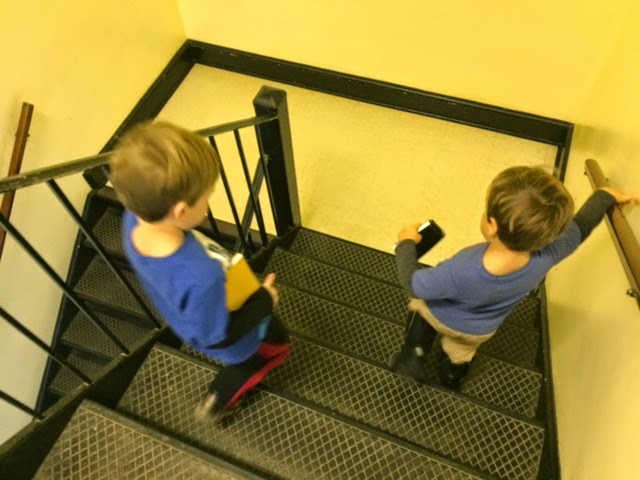
Young boys going to an assignment

Taking their new notebooks and pens, John and Phillip (not their real names) proceed down the stairs to interview one of the teachers of the twos, Sarah. They talk to one another on the way down, trying to decide what questions they will ask her about her job. They enter the classroom, welcomed by the twos teachers, and sit on the floor, ready to write. Here are some of the questions:


Where do you work?    
What's your schedule?
What days do you work?
When do you go to work?
Why do you work?
and lastly,
What time do you go to bed?

These questions are simple, and maybe even obvious, but Sarah treats the children with respect, appearing to contemplate her answers before she gives them. She explains that she works at our center, that her schedule varies each day,and  that she works every weekday. She pauses at the question, Why? How do you explain the reasons for working to small children? She makes the answer seem totally obvious! "I work because I love children, and I need money to buy food". One of the boys admits that his parents work to earn money as well. Sarah decides to say that she goes to bed at ten every night; something the boys understand--they also have a set bedtime! 

During the interview John and Phillip write down the answers, asking Sarah for spelling when they feel unsure of their developmental writing skills.

The next step is to format this edition of our paper, inserting the interview, with pictures taken by myself. Parents will read the stories on the walls of the school, and other children will get to interview our Director. Some stories have been about the new marble run in Creation Station, or about a mother's visit to tell about her newspaper job at the Washington Post. 

Organically, we integrate developmental spelling, drawing, speaking and listening skills into a whole. The whole is more than the sum of its parts. Not only are we integrating literacy and social studies, but we continually nurture connections within the community. Teachers, parents, children are all linked in a learning journey. In a Pre-K program, nurturing relationships between and among all members of the community makes for excellence in education. This is how it should be.